Astronomers led by the University of Warsaw have discovered the first Earth-sized rogue planet—a solitary world drifting through space unbound to any star.
Over 4,000 exoplanets have been confirmed to date, ranging from massive gas giants to rocky worlds, scorching hot to frigid cold. Yet nearly all orbit a host star.
Rogue planets, however, wander the cosmos independently, untethered to any star. A few years ago, this same Polish team from the University of Warsaw provided the first evidence of such objects in our galaxy. Typically massive, their latest find is a milestone: an Earth-sized rogue planet, detailed in The Astrophysical Journal Letters.
Standard exoplanet detection relies on radial velocity—measuring a planet's gravitational tug on its star—or transits, spotting dips in stellar light as a planet passes by. Both require a host star, rendering them useless for rogues.
Enter gravitational microlensing, a phenomenon rooted in Einstein's general relativity. Massive objects warp spacetime, bending light from distant sources.
In strong gravitational lensing, galaxies along the line of sight magnify and distort background objects, revealing ancient, far-off cosmos.
Microlensing scales this down: when a foreground planet precisely aligns with a distant star, it briefly amplifies the star's light, allowing detection and mass estimation.
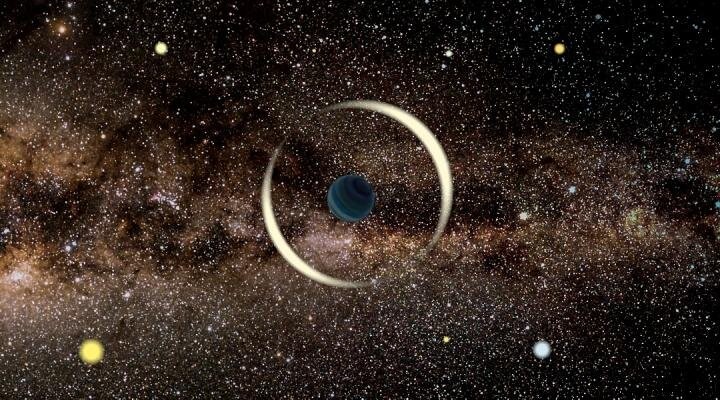
The OGLE survey, spearheaded by the University of Warsaw team, monitors millions of stars toward the Milky Way's core using telescopes at Las Campanas Observatory in Chile, hunting these fleeting microlensing signals.
Their latest detection is the faintest microlensing event on record, signaling an exceptionally small object—less massive than Earth, a featherweight among planets.
Prior rogue planets were spotted from ground telescopes, but the Nancy Grace Roman Space Telescope, launching around 2025, promises unprecedented sensitivity for microlensing, potentially revolutionizing the field.
These insights could reveal how rogues form—likely ejected from protoplanetary disks via gravitational chaos with sibling worlds.
