Astronomers have announced the discovery of TOI-2109b, the gas giant with the shortest orbital period ever recorded. This scorching world completes one orbit around its star in just 16 hours—and it's spiraling inward, potentially facing destruction soon.
Known as "hot Jupiters," these massive gas planets rival or exceed Jupiter's size, with surface temperatures surpassing 1,000 Kelvin (over 700°C). Unlike anything in our Solar System, they huddle dangerously close to their stars, fueling their extreme heat.
Among the roughly 100 hot Jupiters identified in the Milky Way, only a few boast orbital periods under one day. These ultra-close worlds, skimming near their star's surface, are exceptionally rare—making TOI-2109b a standout find.
Led by MIT astronomer Avi Shporer, the team spotted TOI-2109b—located 855 light-years away in the constellation Hercules—using data from NASA's Transiting Exoplanet Survey Satellite (TESS), launched in April 2018.
TESS excels at detecting close-in exoplanets by observing periodic dips in a star's brightness caused by planetary transits. For TOI-2109b, these dips repeat every 16 hours, outpacing any previously known gas giant. Ground-based telescopes confirmed the detection.
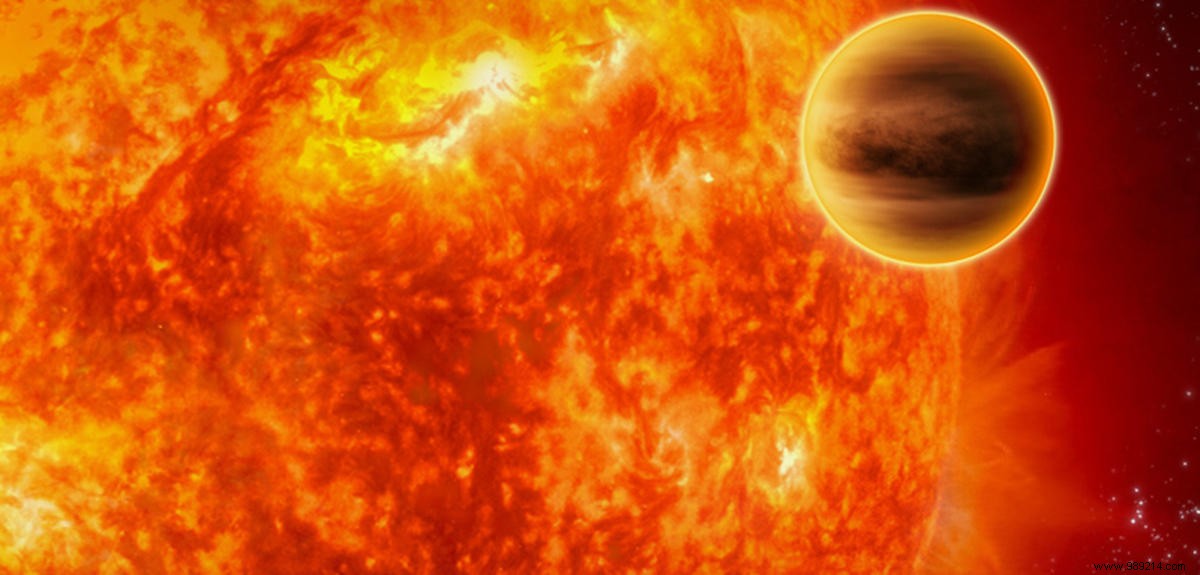
Further analysis reveals TOI-2109b orbits just 2.4 million kilometers from its star—about 24 times closer than Mercury to the Sun. The planet is roughly five times Jupiter's mass and 30% larger in diameter, while its star is twice the Sun's size and mass.
Daytime temperatures on TOI-2109b soar to nearly 3,300°C, ranking it among the hottest known exoplanets. Most compelling is its orbital decay: the planet's orbit is shrinking by 10 to 750 milliseconds per year. While not imminent, models predict it could be engulfed by its star in about 10 million years.
TESS will revisit this system in May and June 2022, offering a chance to observe the decay process firsthand.
