A team of astrophysicists reports that the most massive globular cluster in the neighboring Andromeda galaxy may harbor an intermediate-mass black hole—though no such object has been definitively confirmed to date.
Black holes in the universe fall into three main categories. Stellar-mass black holes, formed from the collapse of massive stars, range from 10 to 100 solar masses. Supermassive ones, with millions or billions of solar masses, typically reside at galactic centers. Intermediate-mass black holes, bridging these extremes with 100 to 1 million solar masses, remain elusive.
Theoretical models predict their existence, but confirmed detections are lacking despite promising candidates. A new study, published in The Astrophysical Journal, highlights a compelling new prospect.
The candidate lurks in globular cluster B023-G078, on the edge of the Andromeda Galaxy, approximately 2.5 million light-years from Earth. This cluster packs the mass of 6.2 million suns and, per the researchers, is likely a stripped core from merged smaller galaxies—with an intermediate-mass black hole at its heart.
Using fresh data from the Gemini Observatory and Hubble Space Telescope, the team mapped the cluster's mass distribution. By modeling stellar velocities, they found the stars orbit too rapidly without a central black hole's gravitational pull.
"The stellar speeds provide direct evidence of some massive dark object at the center," explains Renuka Pechetti, astrophysicist at Liverpool John Moores University. "Globular clusters rarely form such large black holes, but in a stripped core, one could persist as a remnant from an accreted dwarf galaxy."
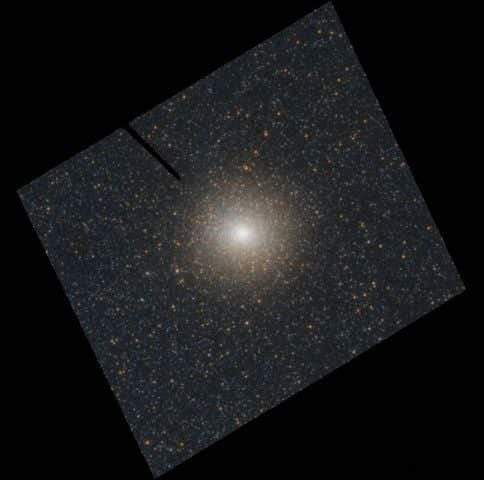
Uncertainty lingers: the signal might stem from a dense swarm of stellar-mass black holes mimicking a single larger one.
Infrared observations from the James Webb Space Telescope could clarify this. The team also eyes three more Andromeda globular clusters for similar signatures.
