Hubble Space Telescope observations, combined with advanced computer simulations, reveal that GJ 1132 b—a nearby exoplanet—lost its original hydrogen-rich atmosphere but later developed a secondary one driven by intense volcanic activity.
GJ 1132 b, located just 41 light-years away, shares striking similarities with Earth: comparable densities, sizes, and ages. Both began with hydrogen-dominated atmospheres and started as hot worlds that eventually cooled. Yet, key differences set them apart.
Earth orbits comfortably distant from the Sun, while GJ 1132 b hugs its red dwarf star so closely that it completes an orbit in just 1.5 days. This proximity tidally locks the planet, with one side perpetually facing its star, much like the Moon to Earth.
This extreme closeness profoundly shaped the planet. In a recent study, astronomers used direct Hubble observations and sophisticated modeling to analyze GJ 1132 b's atmosphere. They found it now consists of a toxic blend of hydrogen, methane, and hydrogen cyanide. Crucially, this is not its original atmosphere.
Millions of years after formation, GJ 1132 b was a vastly different world: a gaseous sub-Neptune far larger than Earth, enveloped in a thick hydrogen envelope. Intense radiation from its young, scorching star rapidly stripped away this primordial atmosphere, leaving behind a bare, Earth-sized rocky core.
A secondary atmosphere then emerged as molten lava from the planet's interior seeped through crustal cracks. These gases continuously replenish the atmosphere, countering ongoing stellar erosion.
This finding reshapes our understanding of exoplanet evolution. "How many rocky planets didn't begin that way?" ponders JPL's Mark Swain. "Some may start as sub-Neptunes and transform over time."
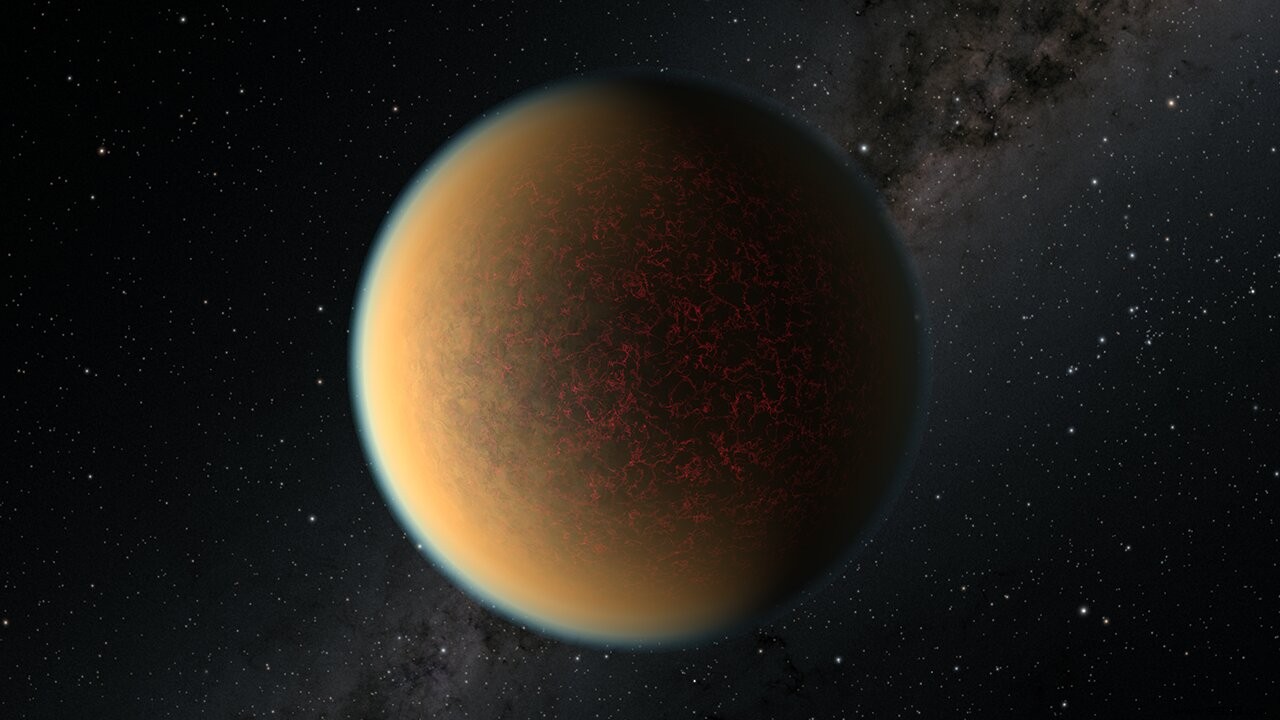
What sustains the planet's mantle in a molten state to power this volcanism? Researchers point to tidal heating—frictional heat generated as orbital and rotational energy dissipates within the planet.
GJ 1132 b follows an elliptical orbit, amplifying tidal forces at perihelion and aphelion. A companion planet in the system adds gravitational tugs, compressing and stretching GJ 1132 b in a constant "pumping" action.
This mirrors Io, Jupiter's volcanically active moon, squeezed in a gravitational dance with Jupiter and its siblings.
Study details appear in The Astronomical Journal.
