The Universe holds many mysteries, particularly its origins—a question that captivates scientists and philosophers alike. Was it created? If so, could the Creator have embedded a message for us? Renowned astrophysicist Michael Hippke from Germany's Sonneberg Observatory investigated this by analyzing the cosmic microwave background (CMB), the faint afterglow of the Big Bang.
Rewind to the Universe's infancy: mere thousands of years after the Big Bang 13.8 billion years ago, it was a hot, dense ionized plasma of protons and electrons, preventing atom formation. As it expanded and cooled, these particles recombined into neutral hydrogen atoms around 380,000 years post-Big Bang. Space cleared, allowing light to propagate freely—this primordial glow persists today as the CMB, bathing all of space.
Years ago, theoretical physicists Stephen Hsu (University of Oregon) and Anthony Zee (University of California, Santa Barbara) posed a provocative idea: If the Universe was created, might its maker have inscribed a message in the CMB's ubiquitous radiation, detectable by advanced civilizations?
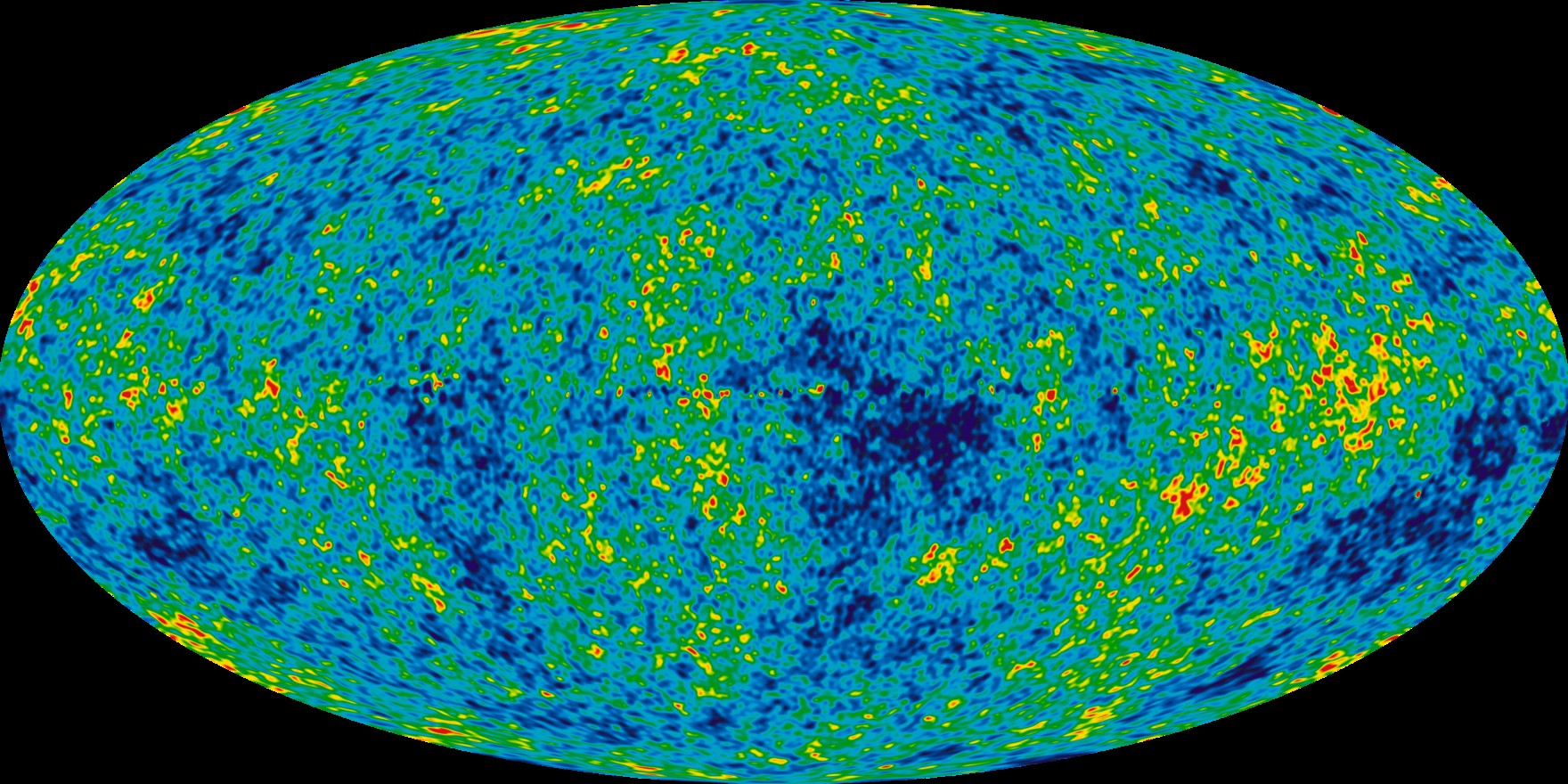
The early Universe wasn't perfectly uniform; density variations created subtle temperature fluctuations in the CMB we observe today. Hsu and Zee theorized a binary message could be embedded in these patterns.
Challenges abound: The CMB has cooled from ~3,000 K at recombination to 2.725 K today. Uniformity across the cosmos is unlikely, and Milky Way emissions obscure full observation, introducing statistical noise. Undeterred, Hippke accounted for these using data from NASA's WMAP and ESA's Planck satellites, extracting a reliable bitstream by cross-comparing datasets.

The first 500 bits are visualized above: black bits match between Planck and WMAP (90% confidence); red bits differ (Hippke favored Planck's ~60% accuracy). Feeding the sequence into the Online Encyclopedia of Integer Sequences yielded no patterns. “I found no meaningful messages in the actual bitstream,” Hippke concluded. “There is no obvious message on the CMB sky.”
Hippke's detailed methodology and results are available on arXiv (pre-peer review).
