Astronomers from the University of California, Riverside, have precisely quantified the Universe's total matter content—both baryonic and dark—by analyzing hundreds of galaxy clusters. Their findings are detailed in The Astrophysical Journal.
For decades, cosmologists have understood the Universe's composition as roughly 5% ordinary baryonic matter that we can detect and interact with, 27% dark matter that neither emits, absorbs, nor reflects light, and 68% dark energy driving the cosmos's accelerating expansion.
This breaks down to about 32% matter and 68% dark energy overall. Accurately pinning down the total matter density remains a cornerstone challenge in cosmology. The UC Riverside team developed the most reliable model yet for this balance.
The researchers created GalWeight, a innovative tool that estimates a galaxy cluster's mass by tracking the orbital motions of its member galaxies.
They applied it to 756 clusters from the Sloan Digital Sky Survey, then compared real-world data against sophisticated computer simulations of cluster formation. By identifying the simulations that best matched observations, they derived the Universe's likely matter content.
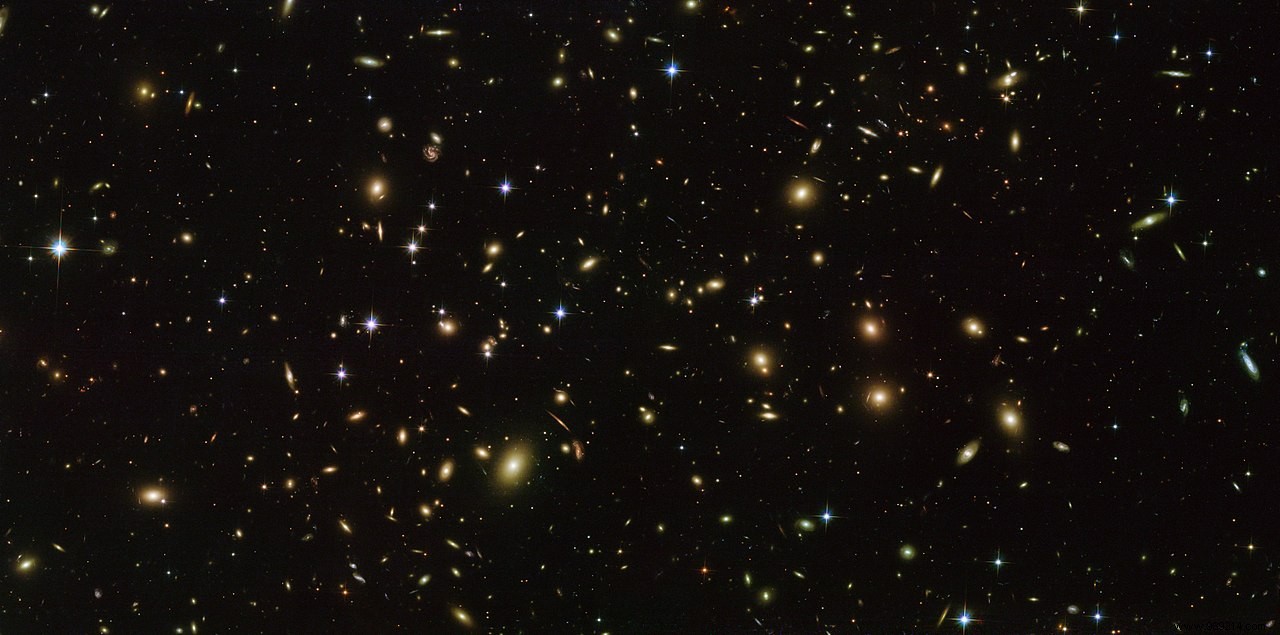
Findings show matter comprises 31.5% (±1.3%) of the Universe's total energy content, with the remaining 68.5% as dark energy.
"To contextualize, if the Universe's matter were evenly spread, its average density would equal just six hydrogen atoms per cubic meter," says lead author Mohamed Abdullah. "Yet, with 80% being dark matter, most isn't hydrogen but an enigmatic substance cosmologists are still unraveling."
Dark matter's profound gravitational influence makes it a central puzzle in astrophysics, despite its invisibility.
Proposed candidates include axions, dark photons, and weakly interacting massive particles (WIMPs), but all remain hypothetical, with no experimental confirmation to date.
Dark energy presents similar enigmas, inferred only through its effects. Unlocking its nature could reveal the Universe's origins and ultimate fate.
