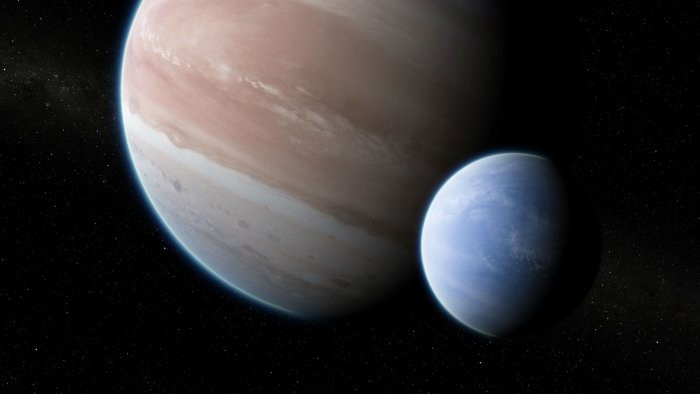
Astronomers led by Columbia University's David Kipping report the possible detection of a second exomoon orbiting a gas giant exoplanet. If confirmed—a process that may take years—this finding suggests exomoons could be as common in the universe as exoplanets.
Over the past three decades, astronomers have confirmed more than 4,000 exoplanets, revealing extraordinary diversity from massive eccentric giants to tight-knit rocky systems. To deepen our understanding of their formation and evolution, researchers are now hunting for moons around these distant worlds.
Given the prevalence of moons in our own solar system, it's logical to expect them orbiting exoplanets too.
Most exoplanets are found via the transit method, where a planet dims its star's light as it passes in front. Detecting moons has proven far trickier, as their subtle luminosity variations are nearly imperceptible.
That changed four years ago when Kipping's team proposed the first exomoon candidate. Hubble follow-up observations a few months later lent support, placing it 8,000 light-years from Earth.
In a new study published in Nature Astronomy, the team announces a second candidate, identified in Kepler data. This exomoon orbits Kepler-1708b, located 5,500 light-years away in the constellations Cygnus and Lyra.
While the first candidate rivals Neptune in size, this one is three times smaller—yet still larger than Earth. Both are likely gas-dominated, possibly rogue planets captured by their host giants' gravity.
Verification will require observations from advanced space telescopes, a process that demands time and precision. Even now, four years on, the first candidate remains under debate without repeated detections.
The pursuit is vital, echoing the initial skepticism toward exoplanets decades ago. Confirming exomoons could transform our models of planetary system formation.
