
The problem to be solved by science is to discover the relationship between definite facts and phenomena in nature, and to establish theories to link facts and phenomena; science is mainly dealing with unknown areas.
The Big Bang marks the Universes birth, but the popular image of a massive explosion from a single point is misleading. This misconception implies a central origin point—yet thats not how it works. So, does our Universe truly have a center? In a conventional explosion, everything erupts from a sp
On Earth, water stably exists as a liquid under our atmosphere and proximity to the Sun. But in the vacuum of space, extreme temperature drops and near-zero pressure create dramatically different conditions. So, does water freeze or boil there?Space is profoundly cold, especially far from stars, wit
In Newtonian gravity, masses attract each other based on their magnitude and separation. General relativity reframes gravity as spacetime curvature induced by mass and energy. But what about massless particles? Do they bend to gravitys influence?Isaac Newtons law of universal gravitation sparked a s
LIGOs groundbreaking detection of gravitational waves marked a new era in astrophysics, deepening our understanding of black holes and their dynamic mergers.On September 14, 2015, shortly after LIGOs activation with enhanced sensitivity, a gravitational wave rippled through Earth. Generated by the c
In 2019, the Event Horizon Telescope (EHT) collaboration completed analysis of 27 petabytes of data from the supermassive black holes at the Milky Ways center and in M87. This groundbreaking effort delivered humanitys first images of a black holes event horizon. But how does the EHT accomplish thi
The landmark detection of gravitational waves—first confirmed over a century after Albert Einsteins prediction—has revolutionized cosmology. With 11 events observed to date, these spacetime ripples have deepened our understanding of the universe. But if gravitational waves arise from gravity itsel
Dark matter makes up about 85% of the universes total matter, dwarfing baryonic matter at just 15%. In the standard cosmological model, it drives galaxy rotation curves and the assembly of vast cosmic structures. It interacts primarily through gravity—so why doesnt it collapse into black holes?In th
In 1976, Stephen Hawking highlighted a profound paradox: general relativity suggests black holes destroy information upon evaporation, clashing with quantum mechanics principle of information conservation. When black holes merge, some mass converts to gravitational waves—does this also erase informa
In the vast cosmos, nothing stays the same forever. Dynamic physical processes continually reshape celestial bodies and their paths. This holds true for our Solar System and countless others, where planets gradually spiral outward from their host stars as they evolve. But what drives this intriguing
Planet X, the hypothetical world lurking beyond Neptune or even the Kuiper Belt, has gained traction among astronomers due to orbital anomalies in trans-Neptunian objects. Robust theoretical models support its existence, yet it remains unseen. What prevents even our most advanced telescopes from spo
Black holes, predicted in 1916 within Einsteins general relativity and confirmed by decades of indirect observations, are now firmly accepted by most scientists. Yet, a few physicists pursue compelling alternatives that match the data just as well. Dark energy stars represent one such idea—a h
As stars exhaust their nuclear fuel, their fates diverge based on mass. Massive stars explode dramatically, forming neutron stars or black holes, while lower-mass stars evolve into white dwarfs. Theoretical models predict a further stage: the black dwarf.A black dwarf is a white dwarf that has coole
Over the past 13.8 billion years, gravity has driven matter to aggregate, compact, contract, and collapse, forming hundreds of billions of cosmic objects hurtling through space—solo or in gravitationally bound systems. In the Universes vast expanse, trajectories often intersect, making collisions in
The multiverse hypothesis arises naturally from established cosmological theories like string theory and eternal inflation. Once viewed as speculative, it has evolved into a core prediction embraced by leading scientists. Yet if our universe shares space with countless others in an expanding multive
Every physical system in the observable universe—from stars and planets to living beings—is built from baryonic matter, the particles of the Standard Model like electrons and quarks. Yet since the 1930s, scientists have hypothesized dark matter, a mysterious substance beyond the Standard Model. It e
Gamma-ray bursts (GRBs) are the universes most powerful explosions, unleashing immense energy in bursts from milliseconds to hours. Often linked to supernovae or massive star collapses, they outshine everything else in the cosmos. But what if one targeted Earth?Most GRBs originate millions of light-
Traveling through space has captivated humanity for millennia. But what if you journeyed in a perfectly straight line to the Universes farthest reaches? Would you venture endlessly forward, or eventually circle back to your origin?When ancient civilizations believed Earth was flat, the idea of retur
Since the Hubble Space Telescopes launch and the advent of advanced observatories, astronomers have captured tens of thousands of stunning cosmic images. While many discoveries are relatively nearby, others push the boundaries, originating from just hundreds of millions of years after the Big Bang.L
Every planet in our Solar System, along with detected exoplanets, exhibits a spheroid shape—nearly spherical, with Earth being a prime example. Yet this prevalent form doesnt rule out some degree of flatness in planetary bodies.For centuries, scientists have confirmed Earths roundness through observ
Earth-based telescopes battle light pollution and atmospheric distortion, while space telescopes offer power but limited access. A lunar telescope could bridge the gap—yet significant hurdles stand in the way, as astronomers have long recognized. At first glance, the Moon appears ideal for ast
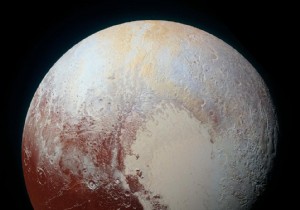 New Horizons Reveals: The Universe is Darker Than We Thought, with Far Fewer Galaxies
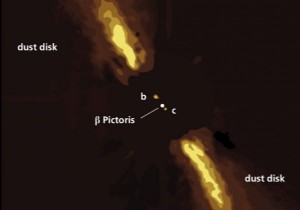 Astronomers Directly Image Young Exoplanet Beta Pictoris c, 63 Light-Years Away
 NASA's Perseverance Rover Lands Safely on Mars: First Surface Photo Revealed
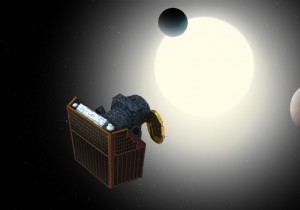 WASP-189b: One of the Hottest Exoplanets Ever Observed by ESA's CHEOPS Telescope
 June 10, 2021 Annular Solar Eclipse: Partial Visibility in France and Best Viewing Spots
