Hubble's analysis of a planet in an extraordinary orbit around a binary star system offers key insights into the elusive hypothetical Planet 9.
In 2015, astronomers detected unusual gravitational influences on Kuiper Belt objects beyond Neptune's orbit. To account for these anomalies, researchers proposed a massive body—five to ten times Earth's mass—on an eccentric path that completes one orbit around the Sun every 20,000 years. Dubbed Planet 9, this faint world remains undetected despite extensive searches.
Now, Hubble's detailed observations of a peculiar exoplanet provide valuable clues to such dynamics.
Published in The Astrophysical Journal, a University of California, Berkeley team describes Hubble's study of exoplanet HD 106906 b, orbiting a binary star system 336 light-years from Earth. Discovered in 2013, this planet's traits were unclear until recent Hubble scrutiny.
HD 106906 b is 11 times Jupiter's mass and orbits at nearly 6.8 billion kilometers (about 730 times the Earth-Sun distance) from its stars—beyond the system's visible debris disk. At just 15 million years old, this youthful system contrasts with our 4.6-billion-year-old Solar System.
The planet takes roughly 15,000 years per orbit in an elongated, highly misaligned path relative to the debris disk, drawing parallels to Planet 9.
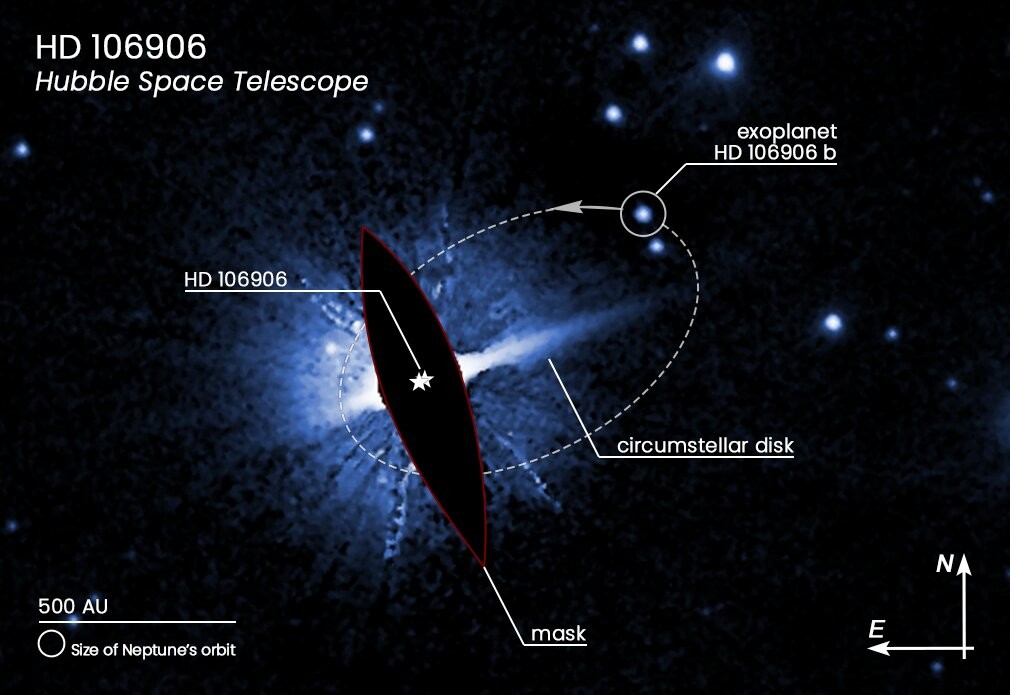
How did it reach this distant position? Simulations suggest it formed much closer to its stars—around three times the Earth-Sun distance—migrating inward amid a gas-and-dust disk. The binary stars' gravity then slung it into an eccentric orbit. A close stellar flyby ultimately stabilized its path, keeping it bound to the system.
The researchers posit a similar history for Planet 9: forming nearer the Sun, scattered by Jupiter, and nudged into stability by passing stars, averting ejection into interstellar space.
"It's like we have a time machine and can see what might have happened when our young Solar System was dynamically active and everything was still shuffled and rearranged," says Robert De Rosa of the European Southern Observatory in Santiago, Chile.
De Rosa advocates targeting HD 106906 b with the upcoming James Webb Space Telescope for even finer characterization.
