Stanford researchers have unveiled a innovative robotic gripper designed to capture space debris—a growing concern for orbital safety. This advanced clamp uses a non-sticky adhesive inspired by nature.
As noted by the European Space Agency (ESA) in December 2020, over 34,000 pieces of human-made space debris larger than 10 cm orbit Earth, traveling at thousands of kilometers per hour. These pose serious risks to satellites and the International Space Station (ISS). To address this, Stanford University engineers developed a robot gripper that securely adheres to objects.
Announced in a May 20, 2021 press release, the gecko-inspired device mimics the lizard's ability to hold its body weight with a single toe. Unlike traditional adhesives, it's not sticky by default but grips firmly when pulled in the right direction.
"The texture is too fine to see, but if you look at it under a microscope, you'll see a forest of tiny, sharp little corners. Like the gecko itself most of the time, it is not sticky. But when you pull in the right direction, it hooks and it hooks really hard. So that gives us a controllable adhesive," explains Mark Cutkosky, a lead researcher on the project.
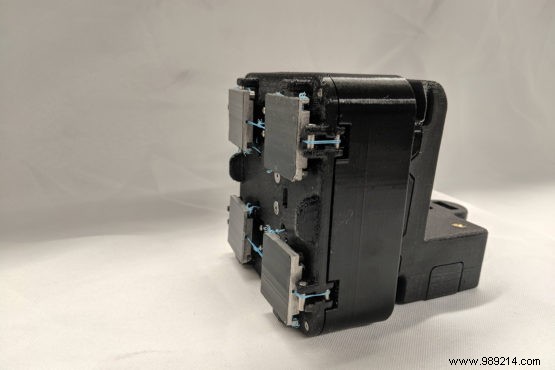
The gripper has proven resilient against space radiation and extreme temperatures. Astronauts previously attached it to ISS walls. More recently, it was integrated with "Honey," one of the station's Astrobees, for microgravity tests (video at article end). Astrobees serve as astronaut assistants and experimental platforms.
During tests, the Stanford gripper enabled an Astrobee to cling to walls. Initially, astronauts will use it for tool recovery on the ISS to automate tasks. In the future, Astrobees equipped with the "Gecko Claw" will target space debris like antennas and solar panels.
Images from the robotic gripper tests aboard the ISS are shown below.
