During a recent gravity-assist maneuver around Venus, the BepiColombo spacecraft captured a striking image of the planet while adjusting its trajectory toward Mercury.
Launched nearly two years ago from Kourou, French Guiana, by the European Space Agency (ESA) and Japan Aerospace Exploration Agency (JAXA), BepiColombo is en route to Mercury, arriving in 2025. Upon arrival, it will deploy two orbiters: ESA's Mercury Planetary Orbiter (MPO) for comprehensive surface mapping, and JAXA's Mercury Magnetospheric Orbiter (MMO) to investigate the planet's magnetic field and magnetosphere. The primary mission is planned for one year.
Reaching Mercury, the innermost planet, demands precise energy management. Rather than a direct path, BepiColombo relies on nine gravity-assist flybys: one of Earth, two of Venus, and six of Mercury to reach its destination orbit.
On April 10, the probe executed its first flyby, passing about 12,700 kilometers above Earth's surface over the Atlantic Ocean.
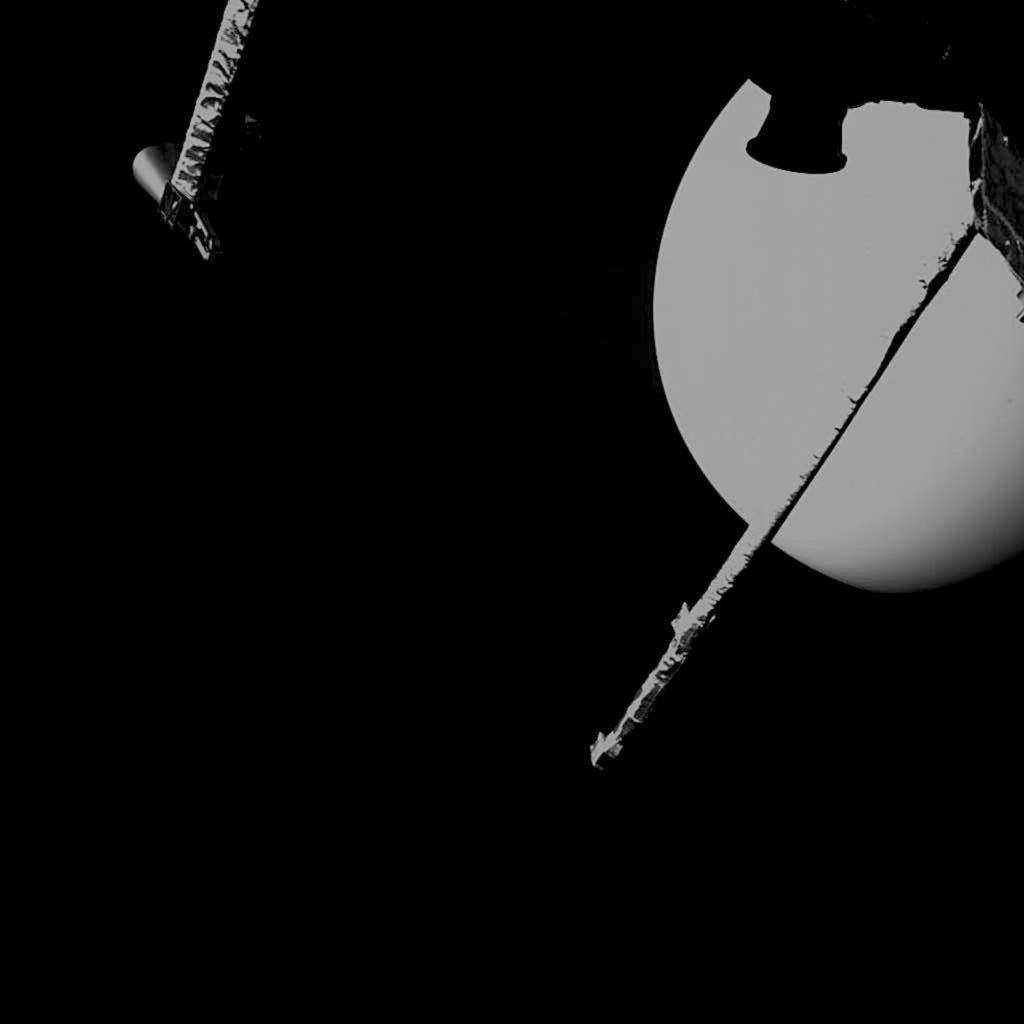
On October 15, BepiColombo conducted its inaugural Venus flyby, approaching within less than 10,720 kilometers, as confirmed by ESA.
Mission teams seized the moment to image Venus using one of the probe's two selfie cameras, as the primary camera was unavailable. In the photo (below), Venus appears at roughly 17,000 km distance, with part of the spacecraft's antenna and magnetometer boom visible.
Additional instruments collected data on Venus's dense atmosphere and its interaction with solar wind—the stream of charged particles emanating from the Sun. More insights are expected from the second Venus flyby in August 2021.
