India's space agency, ISRO, is gearing up for its historic Shukrayaan-1 mission to Venus in 2024, rebounding from pandemic-induced delays. France contributes a key instrument, strengthening longstanding collaborations.
Venus presents one of the Solar System's most inhospitable environments for humans, with average surface temperatures of 462°C and atmospheric pressure 90 times that of Earth's at sea level. Yet, evidence suggests it wasn't always this way—early conditions may have mirrored Earth's, potentially even supporting life.
This intrigue has drawn global attention, from Japan's ongoing missions to NASA's renewed focus. ISRO has now secured approval for its Venus orbiter, joining the effort to unravel the planet's mysteries.
Originally slated for 2023, then pushed to 2025 due to COVID-19 disruptions, the mission is now targeting a 2024 launch, per SpaceNews.
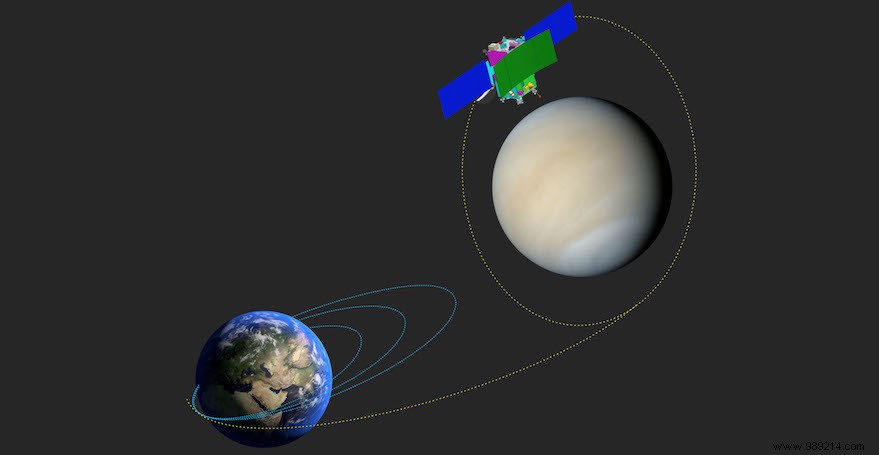
Shukrayaan-1 marks India's debut Venus mission, launching atop a GSLV Mk II rocket.
Over its four-year orbit, onboard instruments will deliver critical data. A synthetic aperture radar will penetrate Venus's thick clouds to map surface features, revealing volcanic activity and subsurface dynamics.
The Venusian Neutral Analyzer, developed with Sweden, will analyze solar charged particles' interactions with the atmosphere.
Additional spectrometers will probe the atmosphere across infrared, ultraviolet, and sub-millimeter wavelengths—building on debated 2020 phosphine detections hinting at possible biosignatures.
France, a key European partner for India, contributes the Venus Infrared Atmospheric Gases Linker (VIRAL) from CNES, co-developed with Roscosmos, enhancing decades of joint space expertise.
