NASA's Perseverance spacecraft, carrying the rover to Mars, encountered minor technical issues while passing through Earth's shadow, entering safe mode temporarily. Officials remain confident in the mission's progress.
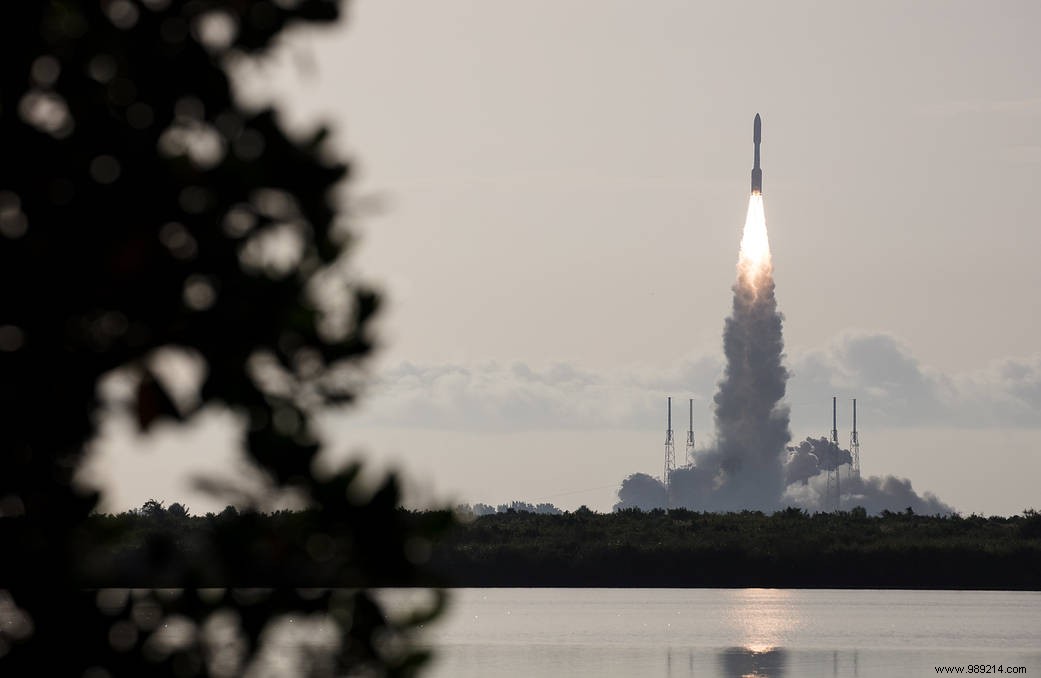
Could Mars have once supported extraterrestrial life? That's the key question NASA's Perseverance rover aims to answer. Launched aboard a United Launch Alliance Atlas V rocket on Thursday, July 30, at 1:50 p.m. French time from Cape Canaveral, Florida, it is set to arrive in the Martian system on February 18, 2021. It will be the fifth rover to reach Mars since 1997.
Shortly after launch, around 8 p.m. on Thursday, NASA faced a few challenges. Matt Wallace, deputy project manager at NASA's Jet Propulsion Laboratory, provided the details.
First, the spacecraft's proximity to Earth post-launch briefly overloaded receivers at NASA's Deep Space Network ground stations. "This is a known phenomenon we've seen on other missions, including the 2011 launch of NASA's Curiosity rover," Wallace explained.
The team adjusted the antennas slightly away from the spacecraft to stabilize the signal, successfully retrieving expected telemetry data.
“The second issue was a brief temperature fluctuation aboard the spacecraft,” Wallace continued. “The mission relies on a liquid freon loop to transfer heat from the spacecraft's core to radiators on the cruise stage—the section guiding the rover to Mars—which face directly into space.”
Operators monitor the temperature differential between the radiators' hot and cold inlets. But as the spacecraft passed through Earth's shadow, sunlight was blocked, causing the outlet temperature to drop.
“This increased the differential between the hot and cold inlets,” the engineer noted. “The anomaly triggered an alarm, prompting the spacecraft to enter safe mode.” In essence, for several hours, only essential systems operated.
This safe mode activation was precautionary. Pre-launch Earth tests couldn't fully replicate the Earth's shadow conditions, and Curiosity's different trajectory offered limited reference data.
“We set conservative temperature differential thresholds,” Wallace said. “It's safer to enter safe mode unnecessarily than to overlook a real issue.”
Operations have resumed normally. “With safe mode cleared, the team is now focused on interplanetary cruise phase,” Wallace confirmed. “Next stop: Jezero Crater.”
