Rocket Lab, a leading aerospace firm specializing in small-payload launches, is set to attempt its first recovery of the Electron rocket's first stage using parachutes in the coming days.
SpaceX has transformed the launch industry over the years by slashing orbital costs through first-stage reusability. Its most recent mission on November 5 for the U.S. Space Force achieved the 64th successful Falcon first-stage recovery since 2015.
Several public and private entities have followed suit. China is developing its own reusable booster, while Russia's Roscosmos recently revealed its "Amur" project. Rocket Lab is joining the effort.
Founded as a private company focused on small payloads, Rocket Lab faced a setback with its Electron rocket's debut in spring 2017 but succeeded on the second try in January 2018, deploying three CubeSat satellites.
The company has since built momentum, orbiting satellites for various clients. It recently secured a NASA contract to launch a microwave-sized CubeSat to lunar orbit. Founder and CEO Peter Beck also envisions a Venus cloud probe.
With strong demand for affordable small launches, Rocket Lab has long explored first-stage recovery methods, inspired by SpaceX. That milestone approaches now.
Rocket Lab announced it will try recovering the Electron's first stage on its mid-November mission. The plan: separate from the second stage at 80 km altitude, reorient the engine section downward using thrusters.
Unlike SpaceX's Falcon 9, Electron's nine first-stage engines won't relight. Instead, engineers will deploy a drogue parachute followed by the main chute, leading to an ocean splashdown (see diagram below).
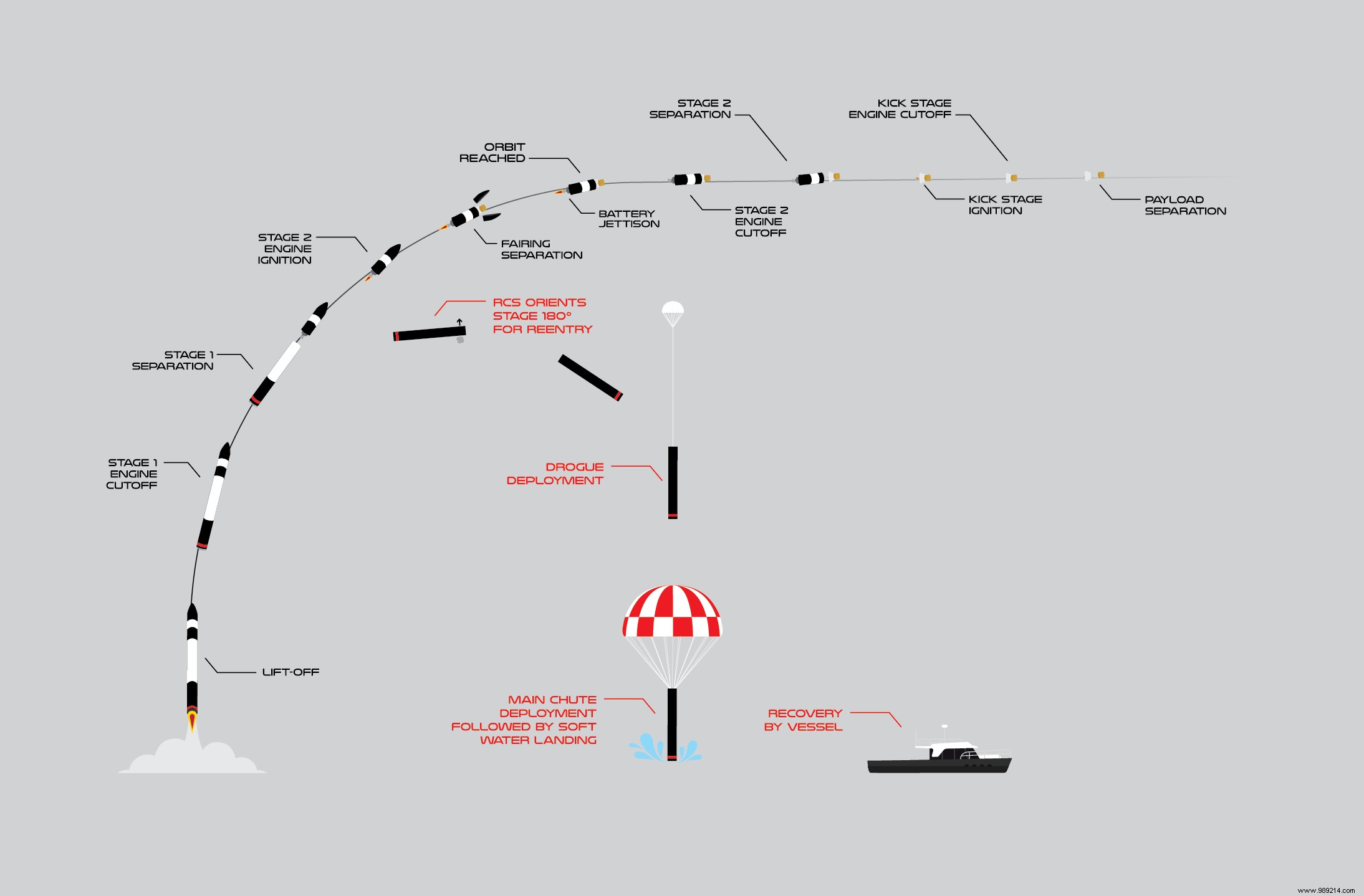
Peter Beck noted during a media call that the exact condition of the recovered stage is uncertain, but the focus is gathering parachute performance data. A recovery vessel will retrieve it from the ocean for analysis at Rocket Lab's New Zealand facility.
Long-term, the vision is helicopter capture mid-air to avoid seawater damage before splashdown.
