NASA, in partnership with Lockheed Martin, is advancing toward the launch of the Lucy spacecraft. It has successfully completed its pre-shipment review, clearing the way to Cape Canaveral, Florida. This groundbreaking mission targets Trojan asteroids sharing Jupiter's orbit around the Sun.
Trojan asteroids orbit the Sun alongside Jupiter, captured by its gravity billions of years ago. They cluster into two groups: the "Trojan camp" at Jupiter's L4 Lagrange point, leading ahead of the planet, and the "Greek camp" at L5, trailing behind.
Scientists suspect many are pristine remnants, virtually unchanged since the Solar System formed 4.6 billion years ago. NASA selected the Lucy mission in 2017 under its Discovery program to investigate these time capsules up close.
Built by Lockheed Martin in Colorado, Lucy carries three proven instruments adapted from prior missions.
The Lucy Long Range Reconnaissance Imager (LORRI), derived from New Horizons, delivers high-resolution visible images of asteroid surfaces. The thermal emission spectrometer, based on OSIRIS-REx's OTES, measures infrared emissions. The L'Ralph instrument—a visible multispectral imager and infrared spectrometer from New Horizons—will map silicates, ices, and organics.
Lucy also features a small plaque echoing the iconic Pioneer 10 and 11 plaques, etched with messages and diagrams.
The mission cleared its pre-shipment review in July 2021 and heads to Cape Canaveral in August for final testing before integration with its United Launch Alliance Atlas V 401 rocket. Launch is slated no earlier than October 16.
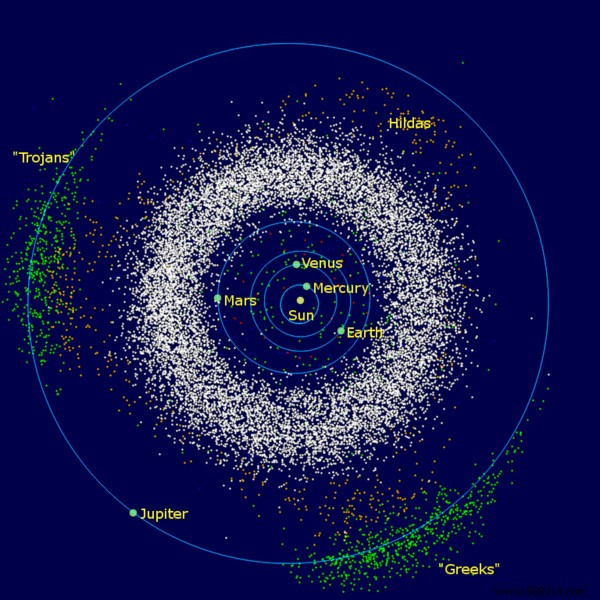
Post-launch, Lucy will use Earth gravity assists in 2022 and 2024 to reach its trajectory. En route to Jupiter, it will rehearse with main-belt asteroid 52246 Donaldjohanson on April 20, 2025.
In 2027, Lucy arrives at the L4 Trojan swarm. Flybys include 3548 Eurybates (64 km diameter) on August 12; 15094 Polymele (21 km) shortly after; Leucus (34 km) on April 18, 2028; and 21900 Orus (51 km) on November 11, 2028.
Lucy then returns for an Earth gravity assist in December 2030, heading to the L5 swarm. In 2033, it will survey the binary pair (617 Patroclus, 113 km; Menoetius, 104 km) in one flyby.
This will make Lucy the first spacecraft to visit eight diverse asteroids in a single mission.
