Since its founding, NASA has launched countless spacecraft, but none quite like DART. Scheduled for late November, this mission will make history by intentionally colliding with an asteroid to alter its orbit—a critical step in planetary defense.
NASA has identified over 90% of asteroids larger than 1 kilometer, yet objects over 140 meters remain a challenge. With potential threats to Earth still possible, proactive defense strategies are essential alongside ongoing detection efforts.
Enter the DART mission (Double Asteroid Redirection Test), NASA's pioneering effort in active planetary protection.
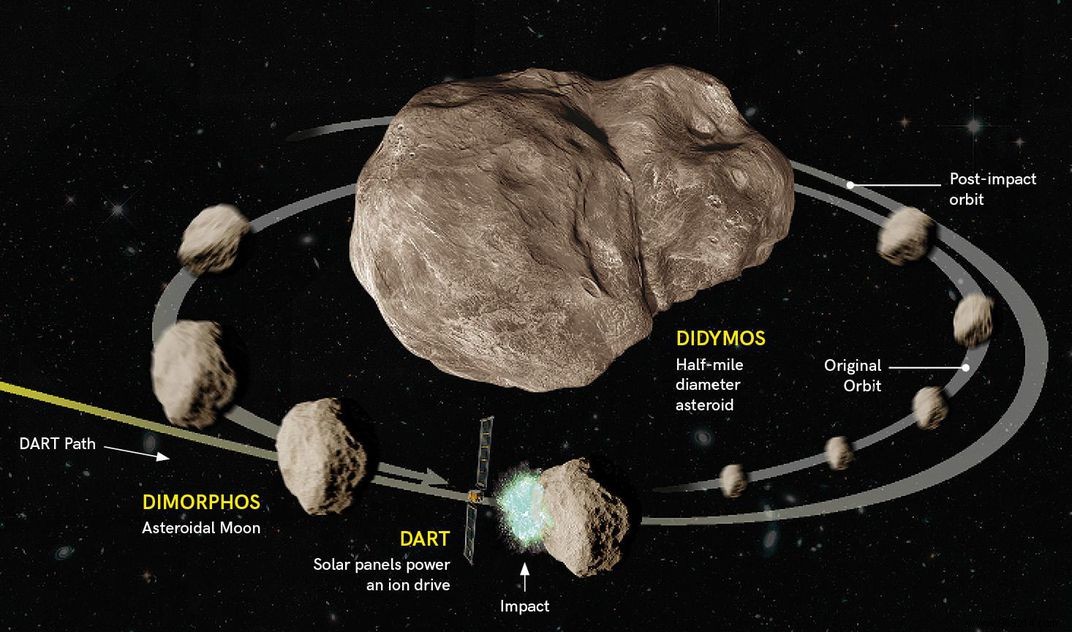
DART targets the binary asteroid system Didymos, a main body 780 meters in diameter orbited by the smaller moon 160 meters in diameter named Didymoon.
Acting as a kinetic impactor, DART will slam into Didymoon. Final approach imaging begins just four minutes before impact, requiring pinpoint accuracy within 15 meters.
The collision must speed up Didymoon's nearly 12-hour orbit by at least 73 seconds—potentially over 10 minutes. Success will be measured via changes in the moon's light reflection timing relative to predictions, confirming orbital alteration.
DART carries a CubSat from the Italian Space Agency, which will detach pre-impact to image the event. In 2024, the European Space Agency (ESA) will send a probe to survey the impact crater.
Costing around $330 million, the mission launches on a SpaceX Falcon 9, with a window opening Tuesday, November 23 at 10:20 p.m. local time. Backup opportunities extend to February 2022. After traveling over seven million kilometers, DART arrives in autumn 2022.
