China's Chang'e 5 capsule has fired its engines, beginning the journey back to Earth with invaluable lunar samples aboard. Success will make China only the third nation—after the US and Soviet Union (now Russia)—to retrieve Moon rocks.
Launched on November 23, the Chang'e 5 mission aimed to collect the first fresh lunar samples in nearly 50 years, since NASA's Apollo program (1969-1972) and the Soviet Luna 16 in 1970. So far, everything is progressing on schedule.
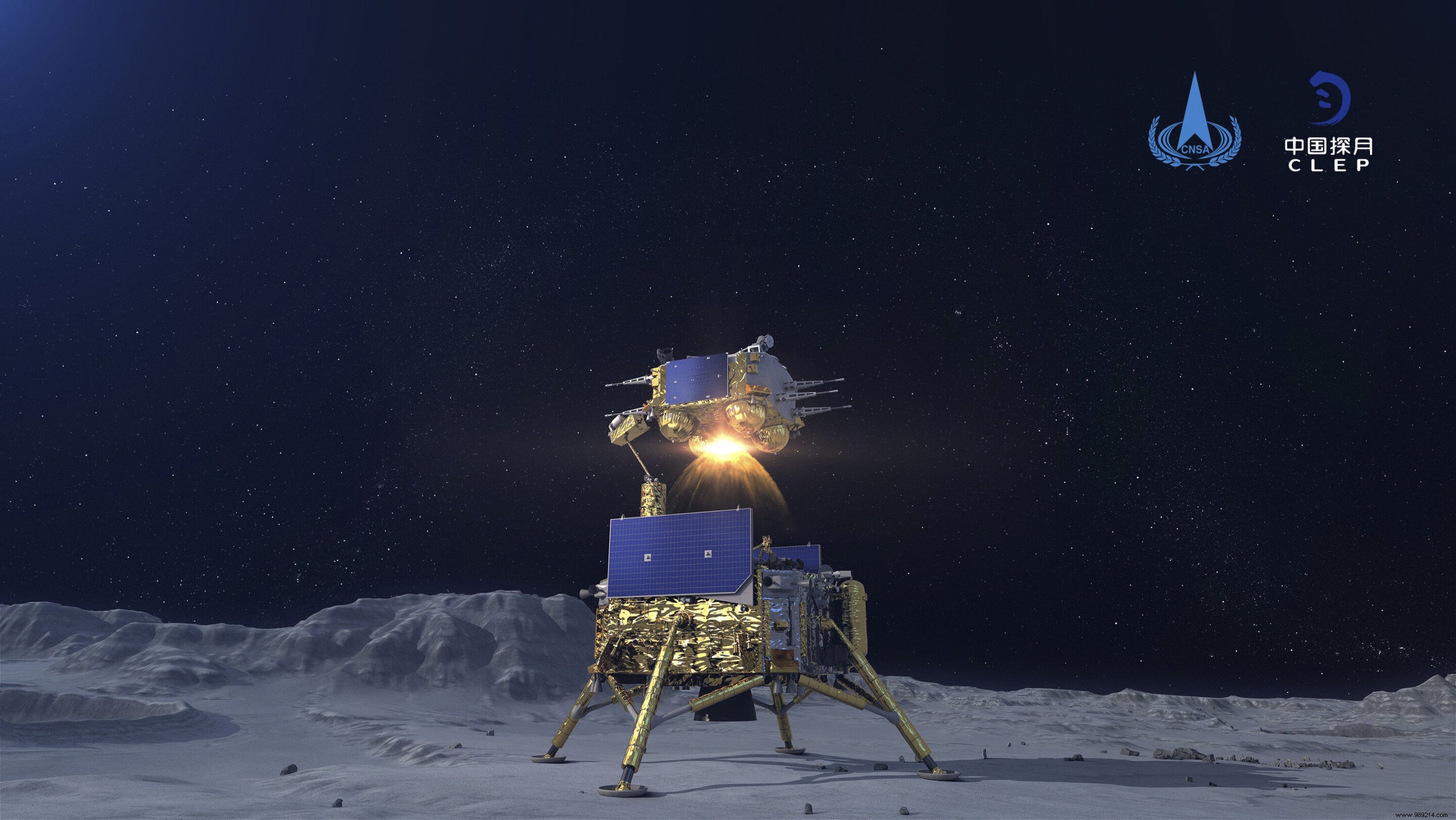
Samples were successfully gathered on December 1 and 2. The ascent vehicle lifted off from the lander the following day, docking in lunar orbit with the orbiter. The two modules successfully rendezvoused on December 5.
The return module lingered in lunar orbit, awaiting a precise launch window for the shortest trip home.
That window opened on December 13. Per the China National Space Administration's social media update, the probe ignited its four engines for about 22 minutes, breaking free from lunar orbit.
The journey should take three to four days, culminating in the sample capsule's release over Inner Mongolia.
Researchers worldwide anticipate analyzing these samples from Oceanus Procellarum, collected both from the surface and via drilling into the lunar regolith. Unlike Apollo and Luna samples, these are significantly younger, potentially revealing key insights into the Moon's geological history.
The age of planetary surfaces is often estimated by crater density, assuming older surfaces endure more impacts. Yet this method lacks precision—prior estimates for Oceanus Procellarum ranged from three billion to one billion years.
Advanced techniques like radiometric dating on these samples will pinpoint the surface age accurately. This data will refine models for understanding terrains on Mars, Mercury, and Venus.
