China's National Space Administration (CNSA) has successfully performed a trajectory correction maneuver for the Tianwen-1 mission, positioning it for an upcoming Mars landing.
As NASA's Perseverance rover continues to captivate the world after its touchdown on the Red Planet, China is readying its own rover for descent. Launched from the Wenchang Spacecraft Launch Site just two days before the U.S. mission, the Tianwen-1 probe entered Mars orbit on February 10. It has now refined its trajectory and will park in orbit until the planned landing in three months.
During this phase, the orbiter will survey Mars' surface, capturing images and data with its high-resolution cameras and sensors to scout the landing zone. The target remains the expansive Utopia Planitia plain, where NASA's Viking 2 achieved a soft landing in 1976.
The descent sequence will deploy a parachute, ignite retrorockets, and inflate massive airbags—echoing the nail-biting techniques used in NASA's 1997 Pathfinder mission.
Success would make China the second country to softly land a rover on Mars, following the United States. These maneuvers are notoriously challenging due to Mars' thin atmosphere, with over a dozen failed attempts since the 1960s.
Golf-cart-sized and powered by solar panels, the Zhurong rover will probe for subsurface water ice and map the planet's geological features.
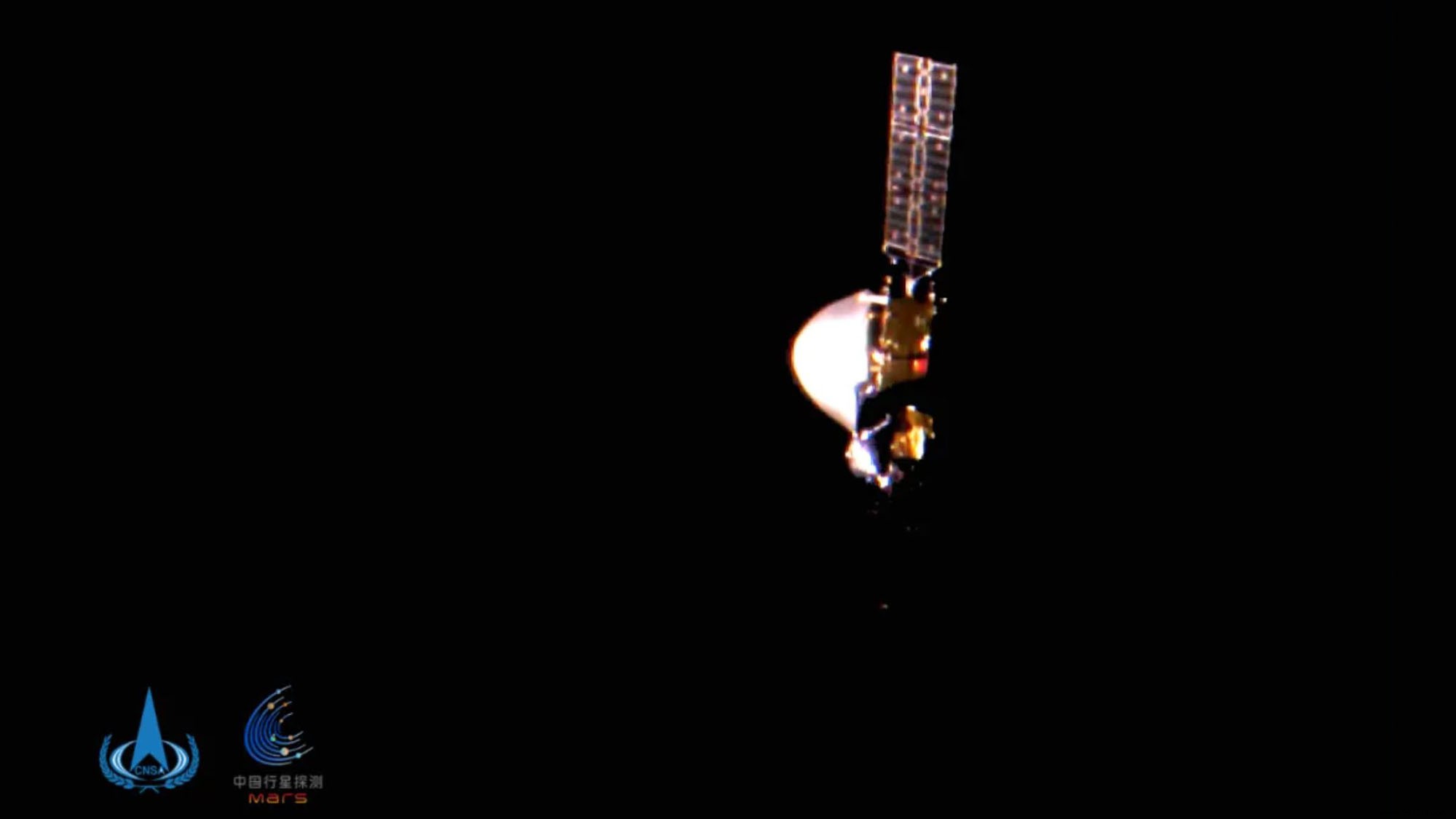
Tianwen-1 stands as the pinnacle of China's space achievements to date. The program sent its first taikonaut into orbit in 2003, retrieved lunar samples last year—the first in over four decades—and landed on the Moon's far side in 2020.
China is also constructing its Tiangong space station to succeed the ISS. Its core module has passed flight acceptance tests and is slated for launch this spring, with a crew arriving weeks later to conduct experiments and train for deep-space missions.
