ESA has awarded Airbus a €491 million contract to design and build the Earth Return Orbiter (ERO), the spacecraft tasked with retrieving and returning Martian samples collected by NASA's Perseverance rover to Earth.
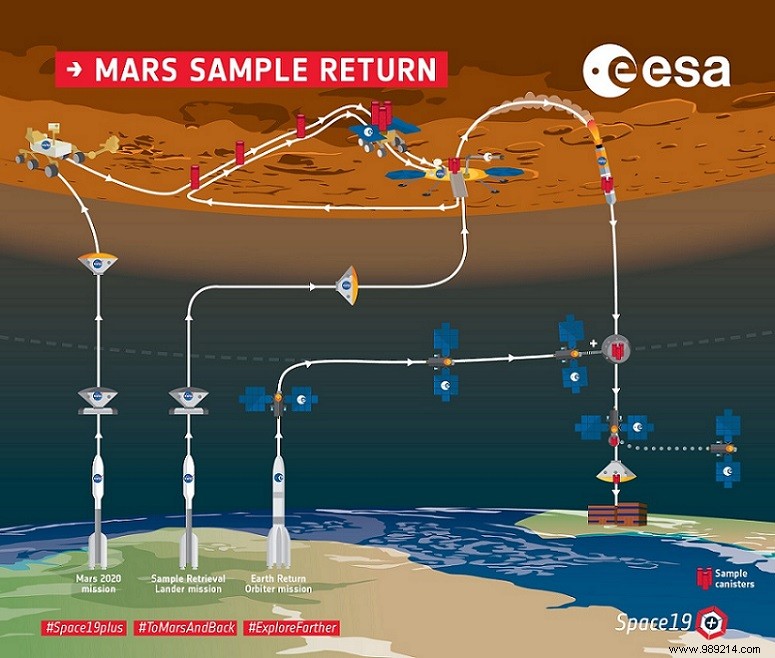
NASA's Mars 2020 mission, launched several months ago, deployed the Perseverance rover to hunt for signs of ancient life on the Red Planet. The rover is caching the most promising rock and soil samples in sealed titanium tubes for eventual high-fidelity analysis on Earth using advanced laboratory instruments.
This ambitious Mars Sample Return program unites NASA and the European Space Agency (ESA). Perseverance will deposit these sample tubes on the Martian surface for retrieval.
In 2026, NASA plans to launch the Sample Retrieval Lander (SRL), which will touch down in summer 2028 and deploy the Sample Fetch Rover (SFR). The SFR will collect the tubes and deliver them to the Mars Ascent Vehicle (MAV), a rocket set to launch in spring 2029, placing the samples into Mars orbit.
Launching in summer 2028, the ESA-built Earth Return Orbiter—crafted by Airbus Defence and Space—will rendezvous with the orbiting samples, secure them, and return to Earth.
Airbus also contributes to the Sample Fetch Rover. With decades of expertise in planetary missions, Airbus is primed for this challenge. The samples are slated for return in spring 2032, with the Earth Entry Vehicle landing in the Utah desert for secure quarantine and analysis.
"We bring all the strength of our experience to ensure the success of this mission," says Jean-Marc Nasr, Head of Space Systems at Airbus. "Bringing samples from Mars back to Earth will be an extraordinary feat that will take interplanetary science to a whole new level."
An interactive app lets you follow Perseverance's path to Mars in real time. The mission targets Jezero Crater on February 18, a site rich in hydrated silica—an ideal preservative for potential ancient biosignatures.
