Kraken Mare, the immense sea of liquid methane on Titan—Saturn's largest moon—could plunge to depths of 300 meters at its center, according to a detailed analysis of 2014 Cassini probe data by Cornell University researchers.
Spanning 5,150 kilometers, Titan ranks as the Solar System's second-largest moon, trailing only Ganymede. Beyond Earth, it's the only world with stable surface liquids. Beneath its thick, golden nitrogen atmosphere, Titan boasts an eerily Earth-like landscape: rivers, lakes, and seas of liquid methane and ethane.
The Cassini mission, orbiting Saturn from 2004 to 2017, mapped the depths and compositions of Titan's seas—except for Kraken Mare, which holds about 80% of the moon's surface liquids. Now, scientists have indirectly unlocked its secrets.
Cornell researchers revisited data from Cassini's T104 flyby on August 21, 2014, when the probe skimmed just over 900 km above Titan's surface at nearly 20,000 km/h.
Cassini's radar altimeter targeted bathymetry in Kraken Mare and Moray Sinus, its northern estuary. By measuring radar echo delays between surface and seafloor, and energy absorption through the liquid, the team gauged depths and compositions.
Moray Sinus clocks in at about 85 meters deep, with a mix of 70% methane, 16% nitrogen, and 14% ethane.
Kraken Mare's central basin yielded no seafloor echoes—indicating extreme depth or high absorption. Assuming a composition akin to Moray Sinus, researchers estimate depths up to 300 meters at the center.
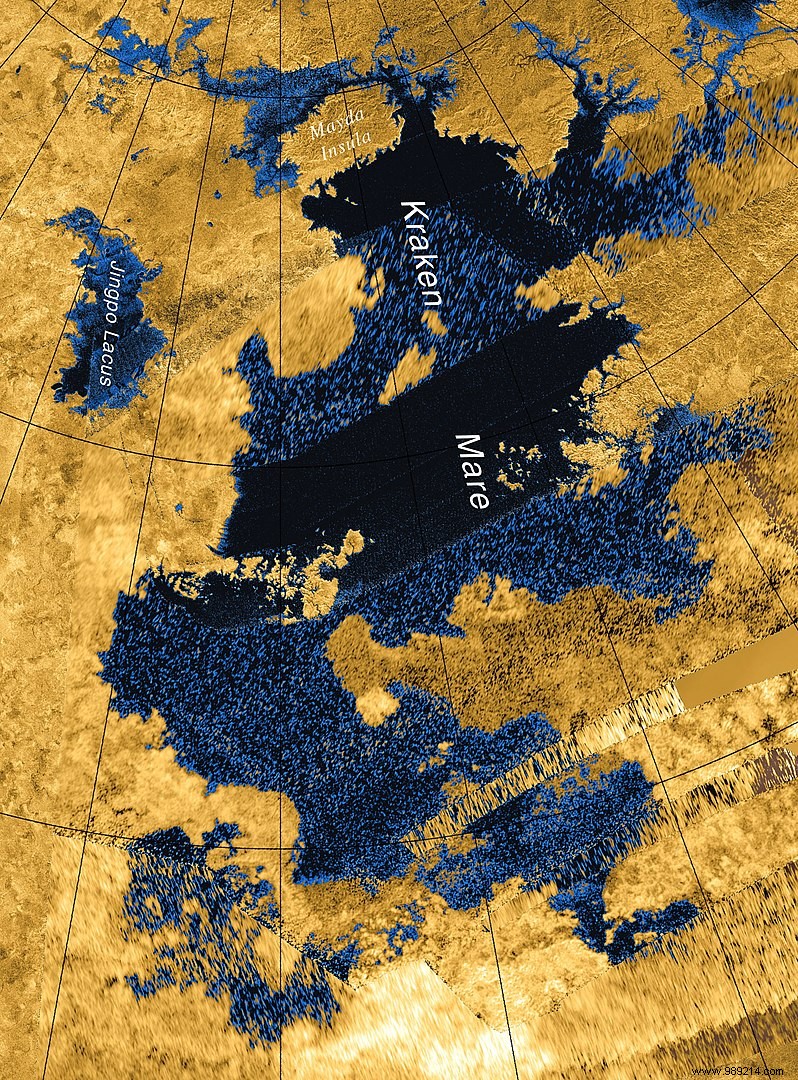
These findings confirm ample space for a robotic submarine in this sea, vast as the five Great Lakes combined (around 400,000 square kilometers). NASA is evaluating such a mission, potentially launching in the 2030s and arriving in the 2040s.
Proposed instruments include hydrocarbon chemistry analyzers, surface imagers, depth sounders, weather stations, and seafloor samplers.
This endeavor could illuminate Titan's potential for life—exotic forms unlike Earth's, as many astrobiologists suspect.
