Expert researchers are advancing a groundbreaking NASA project to probe the vast lakes and seas of liquid hydrocarbons on Saturn's moon Titan. If greenlit, this mission could launch in the 2030s, building on decades of planetary science expertise.
Measuring 5,150 kilometers across, Titan ranks as the Solar System's second-largest moon, trailing only Ganymede. Beyond Earth, it's the sole world with stable surface liquids—though these seas, lakes, and rivers consist of methane and ethane, not water.
Blanketed by a dense atmosphere rich in complex organic chemistry, Titan captivates astrobiologists who see potential for unique life forms, distinct from Earth's biology. Speculation also points to a subsurface ocean of salty water, akin to Enceladus and Europa, possibly sustaining two distinct ecosystems: an exotic surface realm and a deeper, water-based one. Direct exploration remains the gold standard to test these hypotheses.
The Cassini mission (2004–2017) provided our first glimpses of Titan, with ESA's Huygens probe successfully landing in January 2005 after atmospheric profiling.
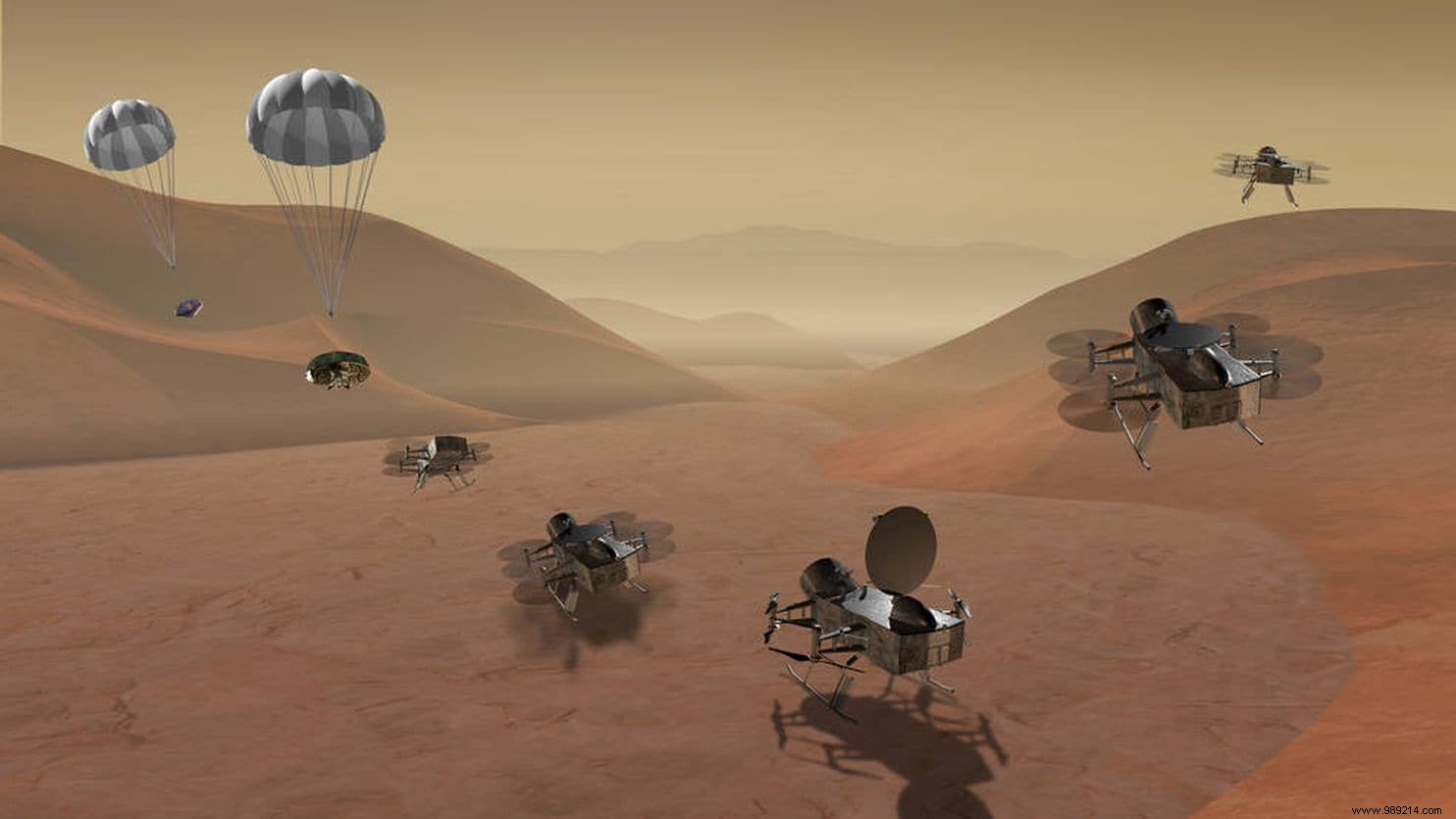
NASA's Dragonfly mission follows suit, deploying a nuclear-powered quadcopter drone. Titan's atmosphere—four times denser than Earth's with one-seventh the gravity—enables leaps of about 10 miles per bound. Onboard instruments will dissect atmospheric organics. Launch is slated for 2026, arrival in 2034.
Following Dragonfly, a nuclear-powered submarine emerges as the next frontier under NASA's Innovative Advanced Concepts (NIAC) program. Principal investigator Steven Oleson affirms its feasibility, citing Titan's mere 14% of Earth's gravity. This reduces pressure on the craft, allowing seamless navigation through hydrocarbons and real-time radio communication to Earth while submerged.
For direct Earth links, the sub would span roughly six meters and weigh 1,500 kg (Earth equivalent). With an orbiter relay, it shrinks to two meters and 500 kg, accommodating advanced tools like hydrocarbon chemistry analyzers, surface imagers, depth sounders, weather stations, and seafloor samplers.

Prime targets: Kraken Mare (400,000 sq km, 35m+ deep) and Ligeia Mare (130,000 sq km, 170m deep) in Titan's northern regions. With a seven-year transit to Saturn, a 2040 (spring) or 2045 (summer) arrival implies a 2030s launch.
