NASA has selected SpaceX to deliver two critical components for the Lunar Gateway, its orbiting outpost designed to enable deep-space human missions.
NASA's Artemis program aims to return humans to the Moon, and a key part of this effort is the Lunar Orbital Platform-Gateway (LOP-Gateway), a mini-station set to become operational around 2028.
This outpost will serve as a vital hub between Earth and the Moon, allowing astronauts to reside there between lunar surface missions. In the future, it could act as a staging point for Mars expeditions.
Positioned in a near-rectilinear halo orbit, the station will approach within less than 3,000 kilometers of the Moon at its closest, enabling quick trips to the surface. At its farthest, it will be about 70,000 km away, allowing resupply shuttles to arrive in just five days.
Assembling the Gateway requires delivering modules to orbit, and NASA has tapped SpaceX for two: the Power and Propulsion Element (PPE, built by Maxar) and the Habitation and Logistics Outpost (HALO, developed by Northrop Grumman).
The $332 million contract (~€273 million) calls for launches aboard the Falcon Heavy, which boasts far greater lift capacity than the workhorse Falcon 9.
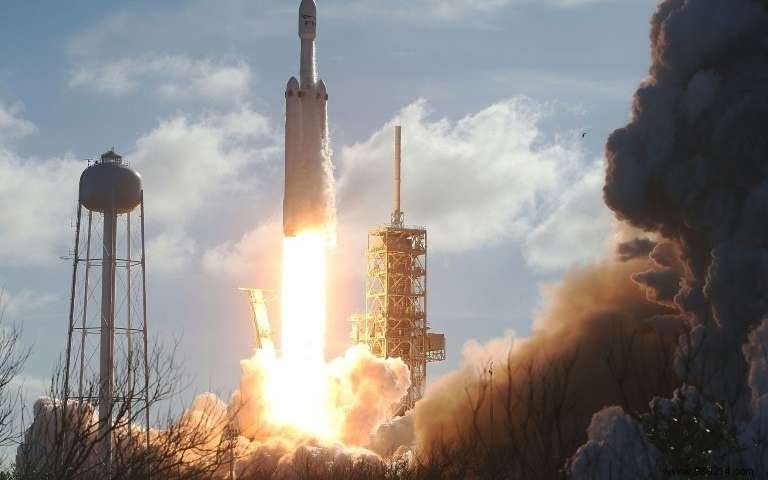
Falcon Heavy made its dramatic debut in February 2018, lofting Elon Musk's Tesla Roadster into space as a test payload instead of a traditional mass simulator.
Since then, it has flown just two commercial missions, on April 11 and June 25, 2019. Its next launch is slated for early this year on a classified U.S. government mission.
The Gateway modules are targeted for launch no earlier than May 2024, though space industry timelines often slip.
