Harnessing artificial intelligence, the Perlmutter supercomputer is set to revolutionize our understanding of dark energy and the Universe's accelerating expansion. Its primary mission: crafting the most detailed 3D map of the observable Universe.
As one of the world's most powerful AI-equipped supercomputers, Perlmutter was unveiled by the National Energy Research Scientific Computing Center (NERSC) at Lawrence Berkeley National Laboratory, under the U.S. Department of Energy's Office of Science. Developed through a collaboration between Hewlett-Packard, AMD, and Nvidia, this machine represents cutting-edge high-performance computing.
Perlmutter's core objective is to generate the most comprehensive 3D map of the visible Universe, enabling precise studies of dark energy—the mysterious force driving cosmic expansion. Data will come from the Dark Energy Spectroscopic Instrument (DESI), mounted on the Mayall telescope near Tucson, Arizona. DESI will capture light from tens of millions of galaxies up to 12 billion light-years away.
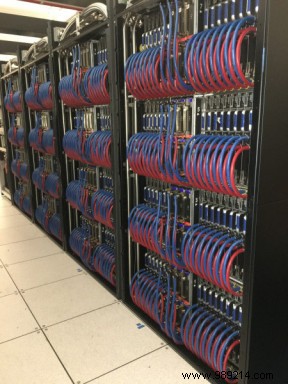
Perlmutter features 1,535 nodes, each powered by four Nvidia A100 GPUs and a 64-core AMD Epyc 7763 processor. Delivering 4 exaflops (4,000 petaflops) of performance, it far surpasses non-AI supercomputers like Japan's Fugaku, which tops out at 415.5 petaflops on the Linpack benchmark. Note that AI supercomputers are excluded from standard TOP500 rankings.
Project leaders expect Perlmutter to analyze a full year's DESI data in mere days—a task that currently takes weeks or months on legacy systems. Still under development, it will soon expand with over 3,000 additional nodes, each equipped with dual AMD Epyc 7763 processors. Beyond cosmology, Perlmutter will also advance research in clean energy technologies.
