The European Space Agency (ESA) and Roscosmos are advancing their joint ExoMars 2022 mission to search for signs of ancient life on Mars. While parachute issues delayed the project last year, recent tests show notable improvements.
For context, ESA and Roscosmos planned to launch ExoMars 2020 alongside NASA's Perseverance rover during last summer's optimal window, sharing the goal of detecting past microbial life. Technical hurdles postponed the launch to summer 2022.
Landing on Mars is notoriously difficult due to its thin atmosphere, which offers limited drag for deceleration. Probes hurtling in at over 20,000 km/h must slow dramatically in roughly six minutes for a safe touchdown.
Like NASA and China's recent successes, ESA and Roscosmos are deploying massive parachutes: a 15-meter supersonic one and a 35-meter subsonic one, each with its own pilot chute.
High-altitude tests last year revealed deployment failures, prompting a delay to avoid risking a Mars surface crash given the mission's high stakes.
On June 24, tests at Sweden's Esrange Space Center in Kiruna lifted an ExoMars capsule mockup to 29 kilometers via helium balloon. It released the smaller supersonic parachute successfully, followed by the larger one.
The larger subsonic parachute sustained minor damage but still decelerated the capsule adequately.
Each main parachute has a pilot chute for proper deployment. Here, the larger one's pilot chute underperformed, causing excess stress and a small tear.
Optimism prevails: "The performance of the second main parachute was not perfect, but much improved [compared to previous tests] thanks to bag and canopy adjustments," noted Thierry Blancquaert, ExoMars program team leader.
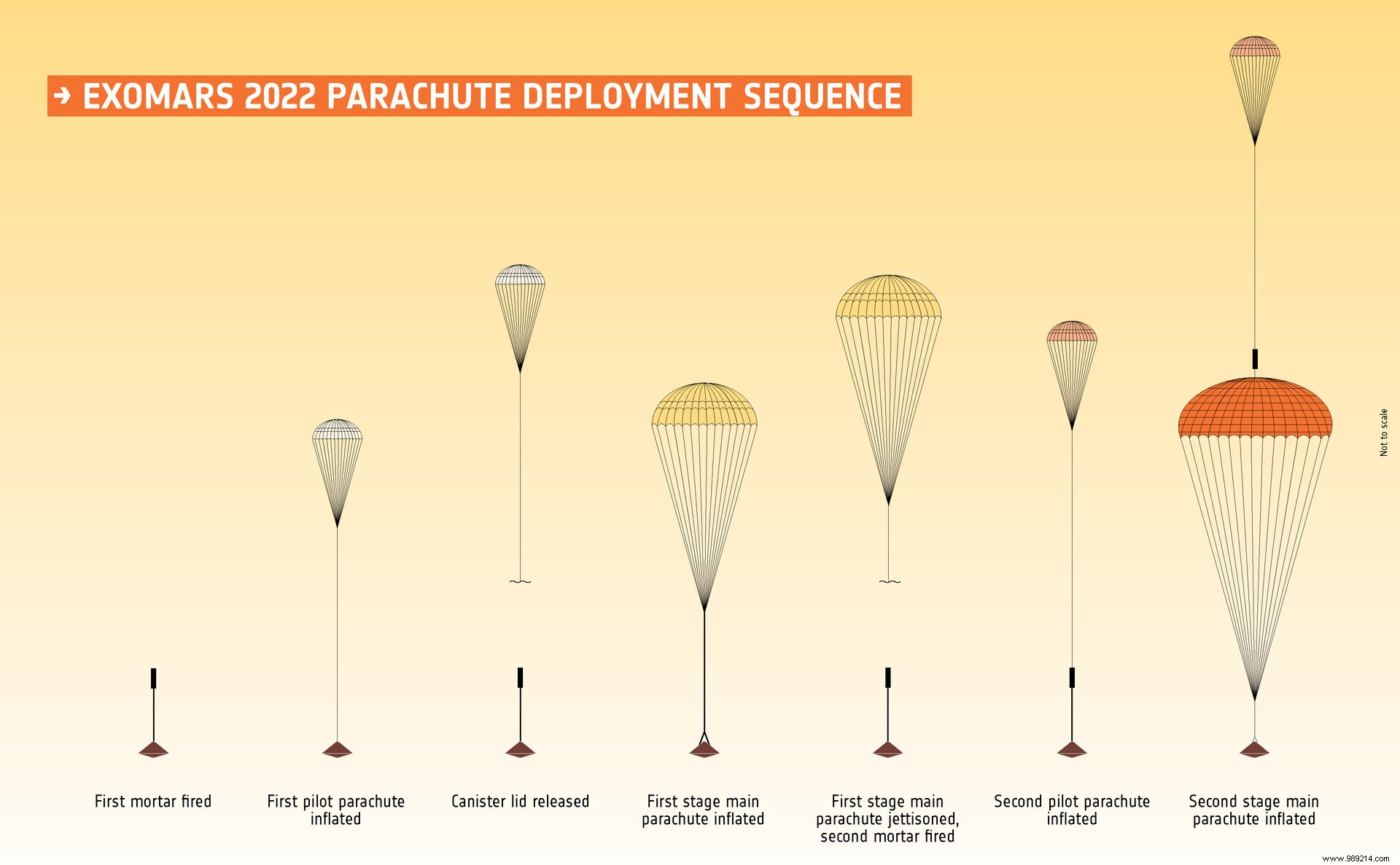
Engineers are analyzing the issue ahead of drop tests in October and November. ESA plans to consult NASA's JPL experts, as before.
If successful, launch could occur in summer 2022, with landing in early 2023.
The mission features a Russian-built stationary science platform to probe the Martian environment. ESA's Rosalind Franklin rover will roam the surface, drill up to 2 meters deep to collect samples, and return them for analysis.
