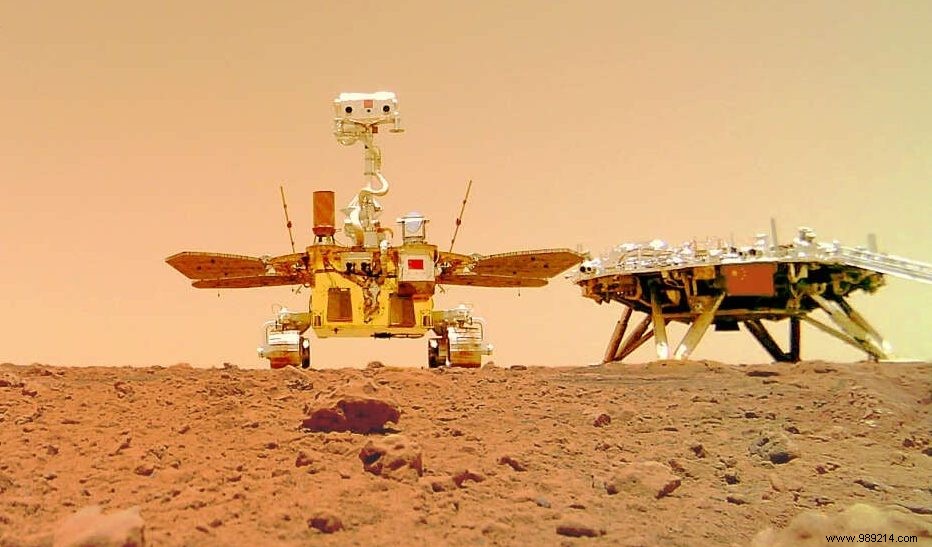
As NASA eyes a crewed Mars mission by the late 2030s and SpaceX aims to accelerate timelines potentially before 2026, China is positioning itself firmly in the race. The Chinese National Space Administration (CNSA) plans its inaugural crewed mission to the Red Planet in 2033, followed by regular flights to establish a permanent human outpost.
China has emerged as a major player in space exploration. Since launching its first taikonaut in 2003, the nation achieved milestones like returning lunar samples to Earth after 40 years in 2020, landing on the Moon's far side in 2018, deploying a Mars rover, and assembling its Tiangong space station at 380 km altitude.
Building on this momentum, CNSA outlined its 2021-2025 priorities at a recent press conference, including lunar exploration, Jupiter missions, and asteroid sample returns.
CNSA Secretary General Xu Hongliang highlighted Mars plans, including a sample return mission. Reuters reports China targeting its first crewed mission as early as 2033.
This won't be a one-off: missions are slated for 2035, 2037, 2041, and beyond, per Wang Xiaojun, head of China's leading rocket manufacturer.
Preparations include probes to scout settlements, robots for in-situ resource utilization—like extracting water ice for oxygen and power generation—and reliable crew return systems.
Recognizing chemical propulsion's limits—requiring 6-9 months per leg with massive fuel—China, like NASA, is exploring nuclear thermal and electric propulsion for faster, efficient round trips.
Wang Xiaojun states success could enable Earth-Mars round trips in "a few hundred days".
