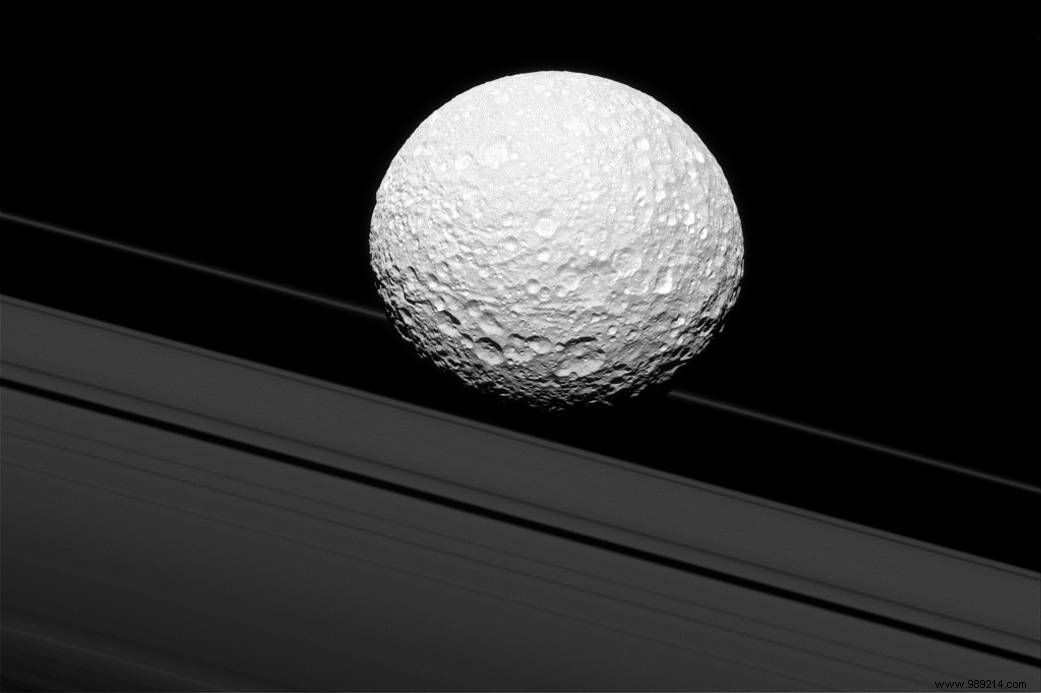
Recent Cassini mission data analysis reveals that Mimas, Saturn's moon resembling Star Wars' "Death Star," likely hosts a subsurface ocean. This discovery makes our Solar System even wetter than previously thought.
Scientists have long focused on the icy moons of Saturn and Jupiter, with Enceladus and Europa as top candidates for extraterrestrial life. Tidal forces from their parent planets drive geological activity, generating enough heat to keep subsurface water liquid beneath their icy crusts.
Mimas, famous for its 130-km-wide Herschel crater, seemed different. Orbiting closer to Saturn in a more eccentric path, it experiences intense tidal stresses yet shows minimal geological activity compared to Enceladus. This led experts to view it as a frozen ice block with little internal dynamism—until now.
Alyssa Rhoden and her team at the Southwest Research Institute (SwRI) analyzed subtle orbital librations detected by NASA's Cassini spacecraft. If Mimas were solid ice, these oscillations shouldn't occur. They indicate either a differentiated core or a liquid layer decoupling the interior from the surface. The team explored the ocean hypothesis.
Their study modeled whether tidal heating could sustain a liquid ocean while preserving Mimas's thick, frozen outer shell.
Digital simulations using Cassini data confirmed that Mimas can sustain a subsurface ocean, explaining the observed librations. Models suggest the ice shell above this global ocean is 24 to 31 kilometers thick. Given Mimas's 396-km diameter, this implies a substantial ocean. The researchers urge further studies for confirmation.
