NASA's Perseverance rover is on the final leg of its journey to Mars. Launched on July 30, 2020, the spacecraft is scheduled to land in Jezero Crater on February 18, 2021, as confirmed by agency officials.
As the core of the $2.7 billion Mars 2020 mission, Perseverance will hunt for signs of ancient life on the floor of Jezero Crater—a 45-kilometer-wide site that once hosted a lake and river delta.
Proving ancient life may prove challenging, mission scientists note, but Perseverance will collect and cache the most promising samples for a future NASA-ESA mission to return them to Earth in the early 2030s—a historic first.
These Martian rocks will enable advanced analysis akin to Apollo lunar samples. "These samples have the potential to profoundly change our understanding of life's origin, evolution, and distribution on Earth and elsewhere in the solar system," said Lori Glaze, director of NASA's Planetary Science Division.
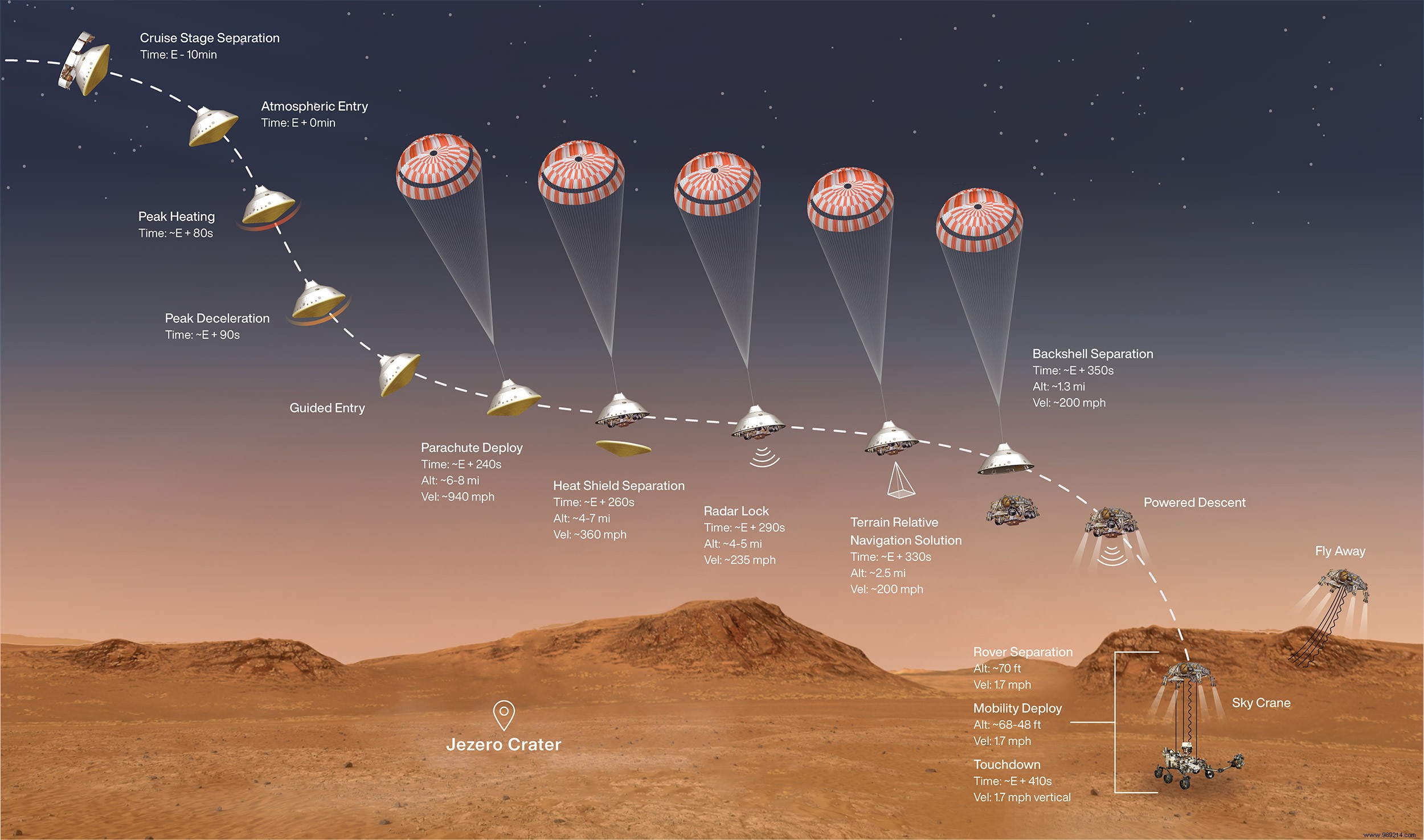
Success hinges on a precise landing. Mars' thin atmosphere makes descent notoriously difficult, especially for Perseverance's 1,025 kilograms—the heaviest rover ever sent there.
"I'm not exaggerating when I say entry, descent, and landing are the most critical and dangerous part of this mission," said Allen Chen of NASA's Jet Propulsion Laboratory. "Success is never assured—especially landing our biggest, heaviest, most complex rover on the riskiest site yet."
Like its predecessor Curiosity, Perseverance faces "seven minutes of terror" with no real-time communication from Earth.
The mission pioneers new tech, including the Ingenuity rotorcraft for several test flights—the first powered flight on another planet. Success could enable aerial scouts for future rovers and astronauts, or independent data collection.
Perseverance also carries MOXIE (Mars Oxygen ISRU Experiment) to produce oxygen from the CO2-rich Martian atmosphere, paving the way for scalable tech to support human exploration.
