In the journal Nature, a team of astronomers reports the discovery of a mysterious, twinkling object that unleashes massive energy bursts toward Earth roughly three times per hour. Located about 4,000 light-years from the Sun, this extraordinarily powerful entity defies comparison to any known cosmic phenomenon.
Astronomers now grapple with a compelling cosmic enigma. Just 4,000 light-years from Earth, this strange object emits powerful low-frequency radio waves for 30-60 seconds every 18.18 minutes. Designated GLEAM-X J162759.5-523504.3 (GLEAM-X for short), it emerged during a recent radio survey of the Milky Way.
Such fleeting phenomena, known as "transients," fall into two categories: "slow transients" like supernovae, which brighten over days and fade after months; and "fast transients" like pulsars—compact neutron stars, 10-30 km across, with intense magnetic fields that pulse X-rays and particles in milliseconds.
Yet GLEAM-X fits neither profile. Observations from Australia's Murchison Widefield Array (MWA) reveal its "on-off" cycle is too rapid for a supernova but far too leisurely for a pulsar.
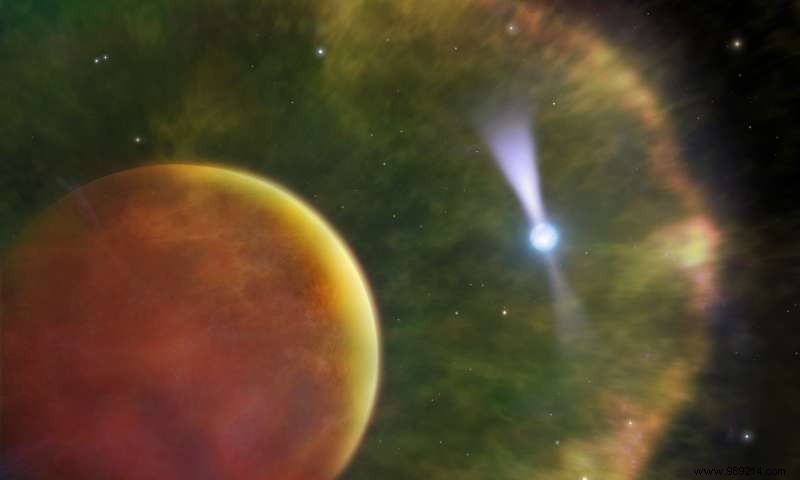
Detailed analysis reveals GLEAM-X as exceptionally bright yet smaller than the Sun, with highly polarized radio emissions indicating an extremely powerful magnetic field.
"No one expected to detect one like this directly—they weren't thought to be so bright," says Natasha Hurley-Walker, a radio astronomer at Curtin University in Bentley, Australia. "Somehow, it converts magnetic energy into radio waves far more efficiently than anything observed before."
These traits align with a theorized "ultra-long-period magnetar"—a slowly spinning, super-magnetized neutron star. Remarkably, no such object has ever been observed. GLEAM-X could represent the first, or an entirely novel phenomenon.
To unravel this puzzle, scientists seek observations across the electromagnetic spectrum and are scouring MWA archives for similar signatures.
