Astronomers from the European Southern Observatory and Max Planck Institute have detected radio signals from a quasar that existed just 780 million years after the Big Bang—the most distant of its kind ever observed.
Quasars are highly energetic galaxies powered by supermassive black holes at their cores, voraciously consuming matter and emitting intense electromagnetic radiation across radio, infrared, visible, ultraviolet, and X-ray wavelengths. These make quasars among the universe's brightest objects, often likened to luminous counterparts of black holes.
Researchers announced the discovery of the farthest quasar known to date—and thus the oldest—detailed in a study published in The Astrophysical Journal.
Spotted using Magellan telescopes at Chile's Las Campanas Observatory, this quasar, named P172+18, revealed its signature through powerful particle jets emanating from above and below its black hole.
Observations capture it as it appeared when the universe was only 780 million years old—roughly 5% of its current age. Analysis indicates the quasar hosted a supermassive black hole with a mass exceeding 300 million solar masses.
This ancient relic offers key insights into the Era of Reionization, a pivotal epoch when the universe was shrouded in neutral hydrogen gas that absorbed most light.
Gravity eventually clumped this primordial gas into the first stars and quasars, which ionized the gas and cleared the way for light to travel freely—ushering in a brighter cosmos.
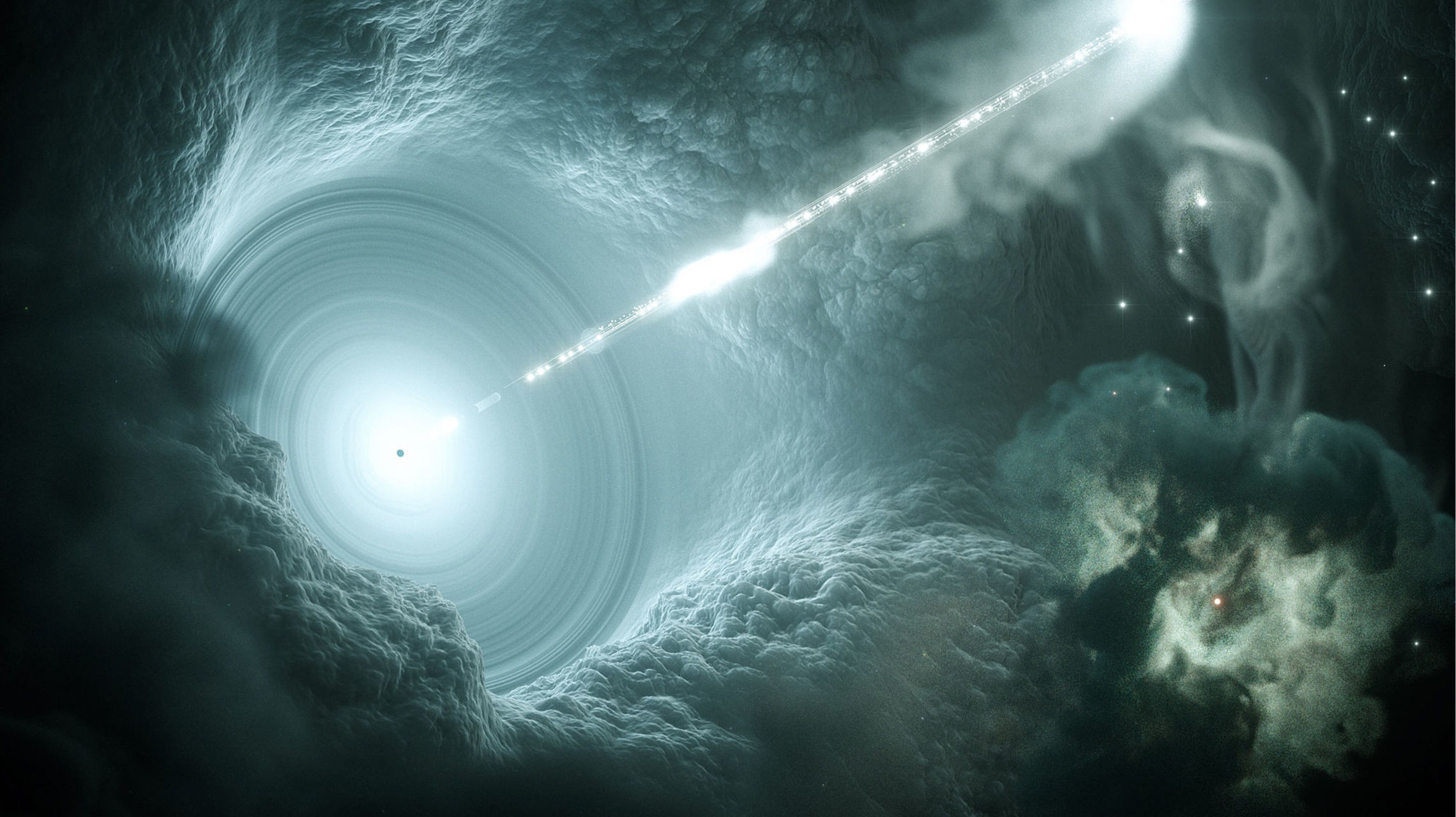
How such massive black holes formed so early remains a puzzle. The standard process begins with the collapse of massive stars, followed by accretion of surrounding matter. However, this timeline struggles to explain their rapid growth.
An alternative: direct collapse of vast clouds of cold, primordial hydrogen gas into black holes, bypassing star formation and enabling faster mass buildup. The exact mechanism is still under investigation.
Notably, by comparing recent data with sky surveys from over two decades ago, astronomers found the quasar has lost half its luminosity, suggesting its active phase may be waning.
