Researchers have unveiled the first magnetic map of the solar corona—the outermost layer of the Sun's atmosphere—offering a breakthrough for predicting solar storms that can disrupt Earth.
The Sun constantly releases solar winds of varying intensity. Powerful eruptions can trigger solar storms that hurl charged particles toward Earth, potentially damaging power grids, communications, satellites, and aviation systems. In 2017, U.S. researchers highlighted coronal mass ejections (CMEs) capable of weakening Earth's magnetic field.
While the Sun's atmosphere includes several layers, scientists focus on the solar corona, which extends millions of kilometers into space beyond the chromosphere. This plasma layer is notoriously difficult to observe: it's extremely tenuous and obscured by the Sun's intense light. Specialized instruments help, but precise data remains elusive, making accurate solar storm predictions challenging.
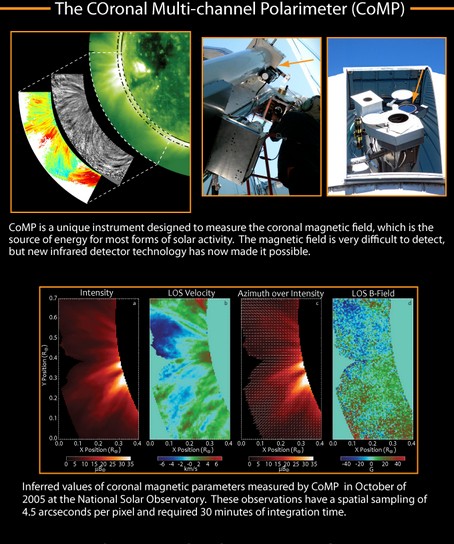
In a landmark study published in Science on August 7, 2020, an international team of researchers introduced the first magnetic map of the solar corona. Since the Sun's magnetic field drives solar winds, this map provides a foundation for developing a reliable predictive schedule.
The map was created using the Coronal Multi-channel Polarimeter (CoMP), a precision instrument that blocks the Sun's glare to reveal surrounding details. This has enabled measurements of plasma density and solar wind speeds. Ongoing research aims to produce routine coronal magnetic maps, akin to those long available for the Sun's surface.
