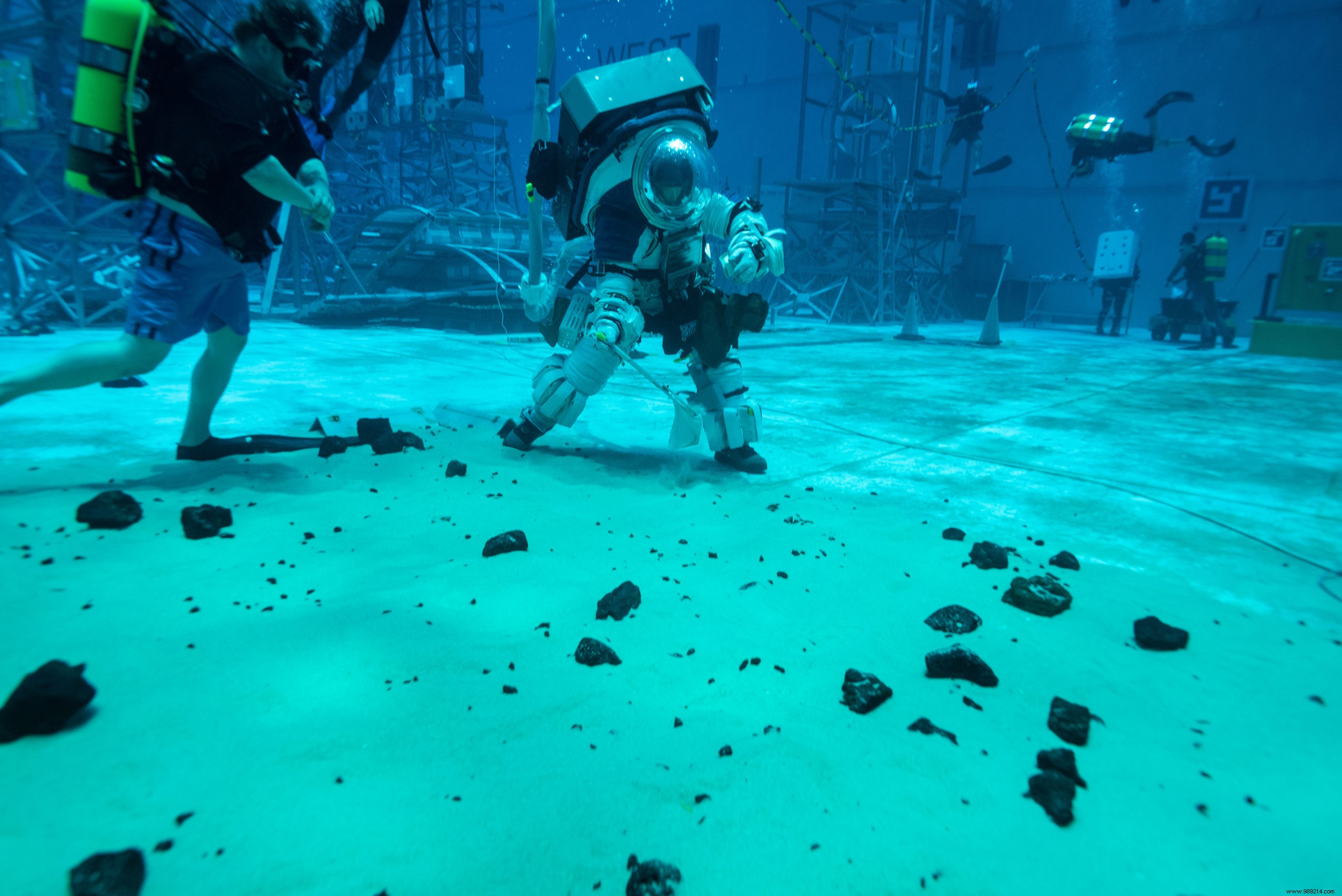
For NASA's Artemis missions, astronauts preparing to walk on the Moon will don advanced new spacesuits. One prototype underwent rigorous testing in the massive pool at the Lyndon B. Johnson Space Center in Houston.
The Apollo-era spacesuits performed admirably as personal spacecraft, but modern missions demand upgrades. With ambitions to return humans to the Moon by 2024, NASA developed the Extravehicular Mobility Unit (xEMU) suits, unveiled just months ago.
Lunar dust—composed of sharp, glass-like particles—poses a primary hazard. The xEMU is engineered to block inhalation and protect the life support system from contamination.
The portable life support backpack, which delivers oxygen and scrubs CO2, is now more compact for extended spacewalks. Helmets pair with integrated earphones and microphones in the upper torso, streamlining communication with crewmates and mission control.
Enhanced hip, knee, and shoulder joints provide superior mobility and freedom of movement for Artemis astronauts.
Engineers tested the suit in the Neutral Buoyancy Laboratory's vast pool at NASA's Johnson Space Center in Houston, Texas—a key training site for spacewalks where underwater conditions simulate lunar gravity (about one-sixth Earth's).
Astronauts practiced essential tasks like collecting Moon rocks and dust samples, climbing ladders, and planting the American flag.

Beyond these primary suits, Artemis astronauts will wear specialized undergarments; the first prototype is complete.
Artemis II aims to orbit the Moon with crew in 2022, paving the way for Artemis III's 2024 landing—the first human Moon touchdown since Apollo 17 in 1972.
