Astronomers have unveiled a remarkably detailed image of a massive sunspot temporarily darkening the Sun's surface. This breakthrough comes from the Daniel K. Inouye Solar Telescope, now in its final testing phase.
Sunspots appear as dark patches on the Sun's surface, forming in areas of intense magnetic activity that block heat from the interior, creating relatively "cooler" regions. Even so, these spots reach temperatures around 4150°C.
To advance our understanding of sunspots and solar phenomena, the U.S. National Science Foundation (NSF) has been constructing the Daniel K. Inouye Solar Telescope since 2013 on Maui, Hawaii.
Featuring a 4-meter primary mirror, it stands as the world's largest solar telescope, delivering unprecedented spatial, temporal, and spectral resolution to observe small magnetic structures—about 20 kilometers across—on and above the Sun's surface.
COVID-19 disruptions delayed construction, but the telescope is poised for full operations by late 2021. During testing, astronomers captured this exquisite view of a huge sunspot that temporarily darkened the Sun's surface on January 28, 2020.
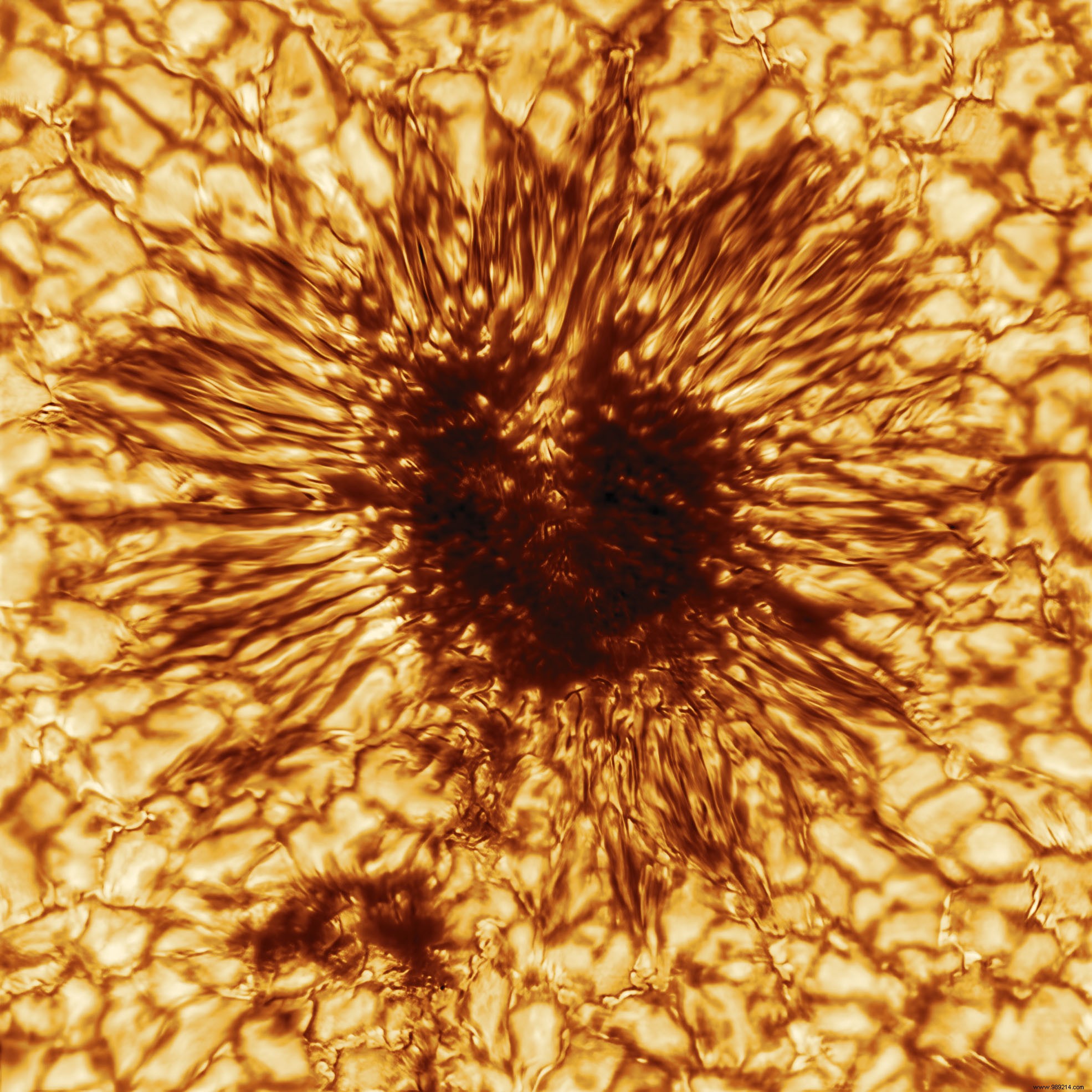
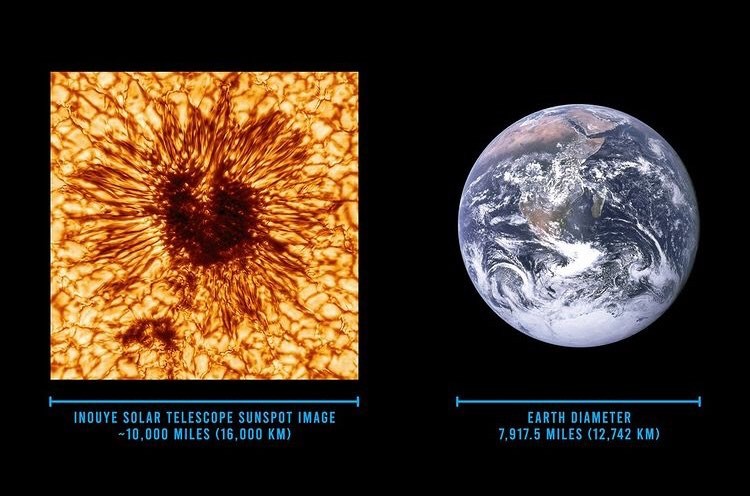
This image spans roughly 16,000 km in diameter—large enough to encompass Earth, which measures 12,742 km across, though it covers just a tiny fraction of the Sun's surface.
Around the sunspot, you'll see "ridged" formations from interactions between hotter and cooler gases, sculpted by powerful magnetic fields.
This sunspot marks an early sign of the new 11-year solar cycle, with activity ramping up toward the anticipated solar maximum in 2025.
For in-depth analysis, see the detailed study in the journal Solar Physics.
