SLAC National Accelerator Laboratory experts have tested the world's most powerful digital camera at Chile's Vera C. Rubin Observatory, successfully capturing its inaugural 3.2-gigapixel images.
Since 2015, researchers at SLAC National Accelerator Laboratory have been developing this unprecedented digital camera, set to become a cornerstone of the Vera C. Rubin Observatory under construction in Chile.
Expected to come online in one to two years, the telescope will survey small bodies in our Solar System, detect thousands of gravitational lenses to study dark matter's gravitational effects, and track the motions of billions of stars and galaxies.
The camera's 60-centimeter focal plane integrates 189 sensors, each delivering 16 megapixels, for a total of 3.2 gigapixels per image. Visualizing this requires 378 4K ultra-HD TVs to display at full scale.
These sensors detect objects 100 million times fainter than the naked eye can see—equivalent to spotting a candle flame thousands of miles away. The ultra-flat focal plane, just a tenth the thickness of a human hair, ensures exceptionally sharp images.
Once operational, the camera will produce repeated panoramic views of the southern sky as part of the Legacy Survey of Space and Time (LSST), a decade-long project illuminating the Universe's formation and evolution.
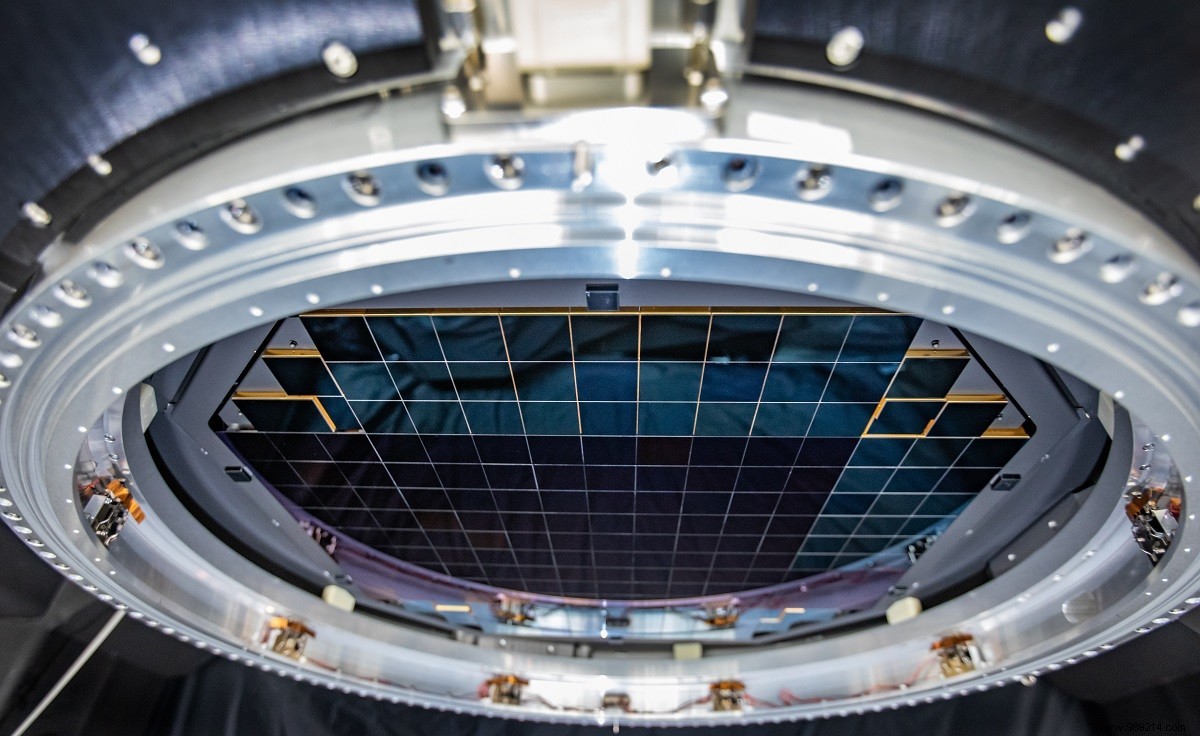
SLAC engineers recently acquired the camera's first images during cryogenic testing, cooling sensors to -101.1°C. Using a 150-micron pinhole projector, they imaged:
– A Romanesco cabbage head (for intricate surface details)
– The Flammarion Woodcut
– A portrait of astronomer Vera Rubin
– A team montage from the telescope project
– Logos of partner institutions.
Note: Images are zoomable for closer inspection.
“Capturing these images marks a major milestone,” said LSST project director Aaron Roodman. “With such precise specifications, we've optimized every square millimeter of the focal plane to maximize scientific discoveries.”
Later this year, the team will integrate the lens, shutter, and filter systems. Following final tests, the camera will ship to Chile for installation at the observatory.
