NASA's Parker Solar Probe has completed its tenth close approach to the Sun, achieving two remarkable milestones. On November 21, the spacecraft came within less than 8.5 million km of the Sun's surface, hurtling at over 586,000 km/h.
Launched by NASA nearly three years ago, the Parker Solar Probe is designed to unravel two key solar mysteries by venturing unprecedentedly close to the Sun.
Why is the Sun's corona millions of degrees hotter than its surface, which measures just thousands of degrees? Additionally, what drives the solar wind—the stream of charged particles accelerated from the corona that permeates our Solar System? This mission equips scientists with vital data to decode these phenomena.
The probe's path involves 24 orbits around the Sun, each drawing it closer, aided by Venus's gravitational assist. On November 21, during its tenth perihelion, Parker approached within 8.5 million km of the Sun's surface—the closest any human-made object has ever come to our star.
It also eclipsed its previous speed record, reaching over 586,860 km/h, cementing its status as the fastest spacecraft ever built.
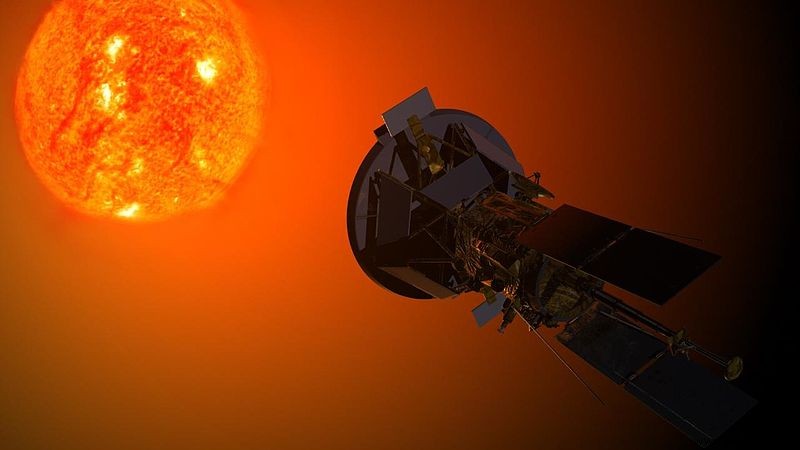
Future flybys promise even bolder feats: by 2025, Parker is slated to skim within less than six million km of the Sun at a blistering 692,000 km/h. How does it survive without incineration?
The key lies in distinguishing temperature from heat, especially in the vacuum of space. Temperature gauges particle speed; heat quantifies energy transfer. Space's low density means fewer particles interact with the spacecraft, transferring minimal energy despite extreme temperatures.
Consider touching a scorching oven versus boiling water: the oven's sparse air allows brief tolerance of higher temperatures, unlike water's dense medium. Similarly, the corona's lower density shields Parker from the full brunt of the Sun's heat.
