A NASA team is developing an innovative mission to explore the interstellar medium, tackling key questions beyond the reach of the Voyager probes.
Voyager 1 and 2 have ventured into interstellar space for years, providing valuable data on its composition where the Sun's influence wanes. However, their primary mission focused on the outer planets—Jupiter, Saturn, Uranus, and Neptune—leaving them under-equipped for detailed interstellar analysis.
NASA now aims to launch a dedicated probe with specialized instruments for this environment. Details emerged at the 2021 European Geosciences Union General Assembly.
"The interstellar probe would venture into the unknown local interstellar space, uncharted by humanity," explained Dr. Elena Provornikova of the Johns Hopkins Applied Physics Laboratory. "For the first time, we could image our vast heliosphere from outside, revealing what our solar system home truly looks like."
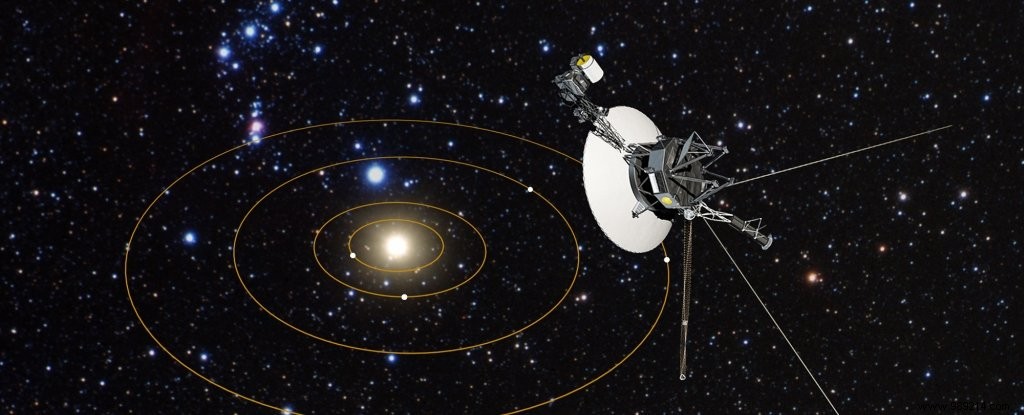
Dr. Provornikova's team is finalizing a four-year concept study to outline mission goals and required instruments. A similar proposal surfaced in 1999 but didn't advance.
If approved, launch could occur in 10 to 12 years, with about 15 years to reach the heliosphere—far quicker than the Voyager probes' 35 years.
This mission is far more ambitious: Voyager 1 is currently at 152 astronomical units (AU) from the Sun. The new probe targets data collection up to 1,000 AU. While Voyager, Pioneer, and New Horizons will eventually reach such distances, contact will have long been lost.
Key objectives include sampling the interstellar medium for composition, ionization, and magnetic fields. It would also reveal how solar plasma interacts with interstellar gas to form the heliosphere, define its boundaries, and potentially confirm its shape.
