China's Tianwen-1 mission, the nation's first interplanetary endeavor, successfully landed its Zhurong rover on Mars. Comparable in size to a golf cart, the rover will investigate subsurface water ice and map the planet's geological features.
On May 15 at around 4 a.m. Beijing time, the Tianwen-1 probe released its lander and Zhurong rover, conquering the riskiest phase of their 10-month journey. Hours later, the pair pierced Mars' atmosphere inside a protective capsule at over four kilometers per second.
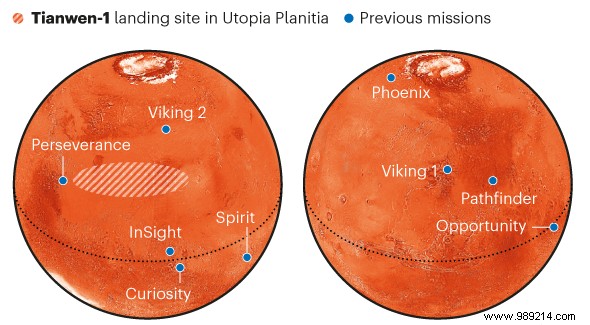
The landing sequence unfolded with parachute deployment, retrorocket ignition, and inflatable airbags. The lander touched down safely in the vast rocky plain of Utopia Planitia—a feat previously achieved only by Russia and the United States.
This triumph underscores China's rapid strides in space exploration. Since launching its first taikonaut in 2003, the nation retrieved lunar samples in 2020—the first in 40 years—and landed on the Moon's far side in 2019. China is now constructing its own space station to follow the International Space Station.
Soon, the 1.85-meter-long, 240-kg, six-wheeled rover will deploy from the lander. Designed for a 90-Sol (92.5 Earth-day) lifespan, it could endure much longer, much like NASA's Spirit and Opportunity rovers. China's Yutu-2 lunar rover, with a similar planned duration, has operated for over two years.
Utopia Planitia, Zhurong's landing site, is a vast, flat basin shaped by a massive impact billions of years ago. Its volcanic surface may bear traces of ice freeze-thaw cycles, with scientists eager to detect subsurface permafrost.
Zhurong carries advanced tools: two cameras for rock imaging, a multispectral camera, and a laser spectrometer for composition analysis. Ground-penetrating radar, akin to NASA's Perseverance, will probe geological history.
The orbiter will relay Zhurong's data to Earth while studying Mars' upper atmosphere, solar wind interactions, and magnetic field dynamics.
