ESA's ExoMars Trace Gas Orbiter (TGO) has captured a remarkable image of a Martian crater that closely resembles a massive tree stump, complete with concentric rings. What natural processes created this intriguing feature?
Launched in 2016 through a partnership between the European Space Agency (ESA) and Roscosmos, the ExoMars Trace Gas Orbiter (TGO) orbits Mars to analyze its atmosphere. The mission specializes in detecting trace gases and isotopes, while mapping spatial and temporal variations in methane distribution to pinpoint potential sources.
TGO also supports data relay for the ExoMars Rosalind Franklin rover and Kazachok platform, originally planned for 2022 but delayed by the pandemic, with a launch now set for next September.
Beyond atmospheric science, TGO's CaSSIS (Colour and Stereo Surface Imaging System) camera frequently images Martian terrain, uncovering surprises like this recent discovery.
Shared by ESA on June 13, 2021, the image showcases a peculiar formation in the northern plains of Acidalia Planitia—a site familiar from the sci-fi novel and film The Martian.
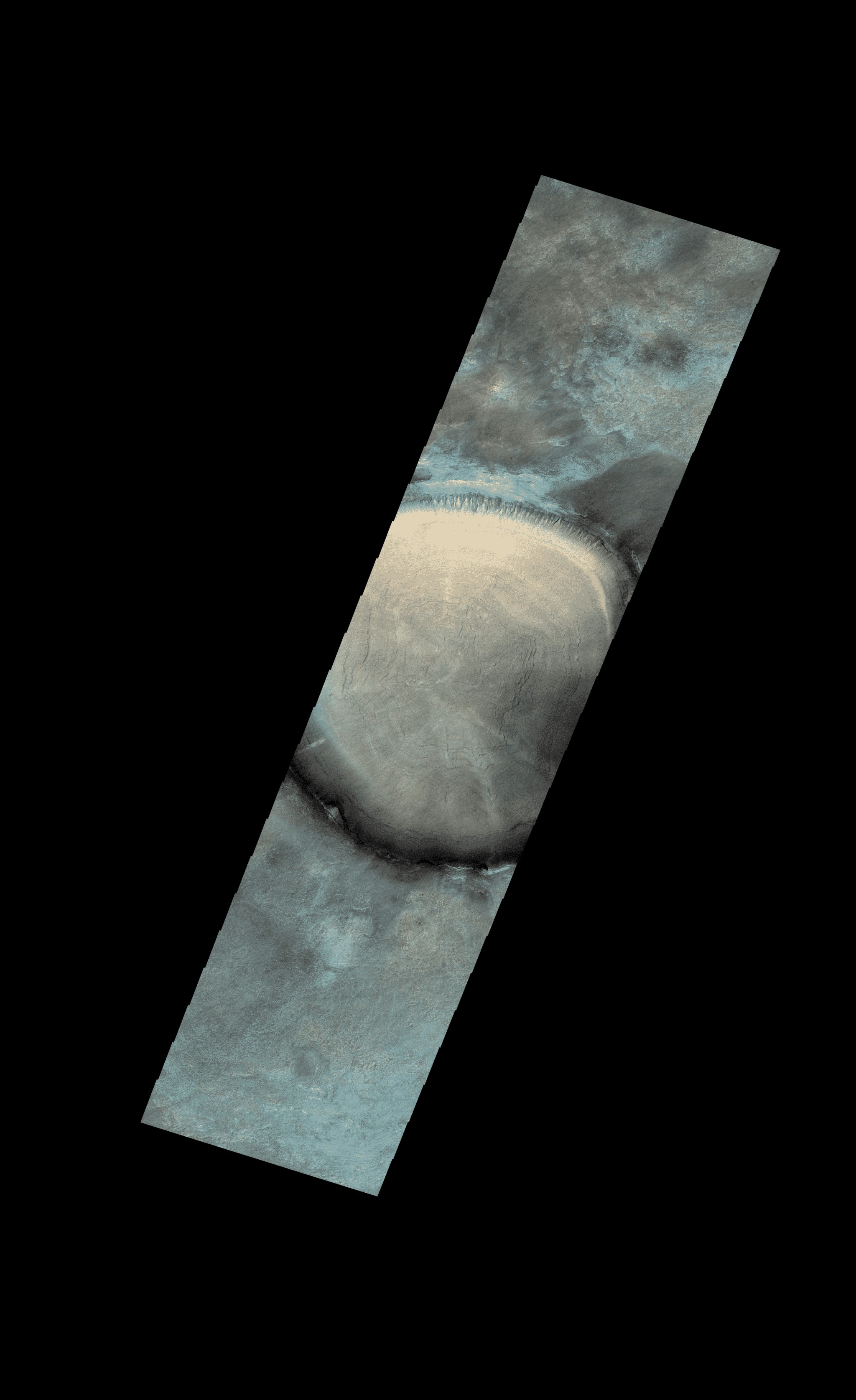
Unlike annual tree rings on Earth, these crater patterns don't mark age. Instead, much like tree rings chronicle climate history, these features—shaped by Mars' dynamic past—offer insights into the planet's geological evolution.
ESA experts note the crater is rich in water ice, with layers deposited millions of years ago due to shifts in Mars' axial tilt. The prominent cracks result from seasonal temperature fluctuations, causing the icy material to expand and contract.
