Astronomers analyzing the light curve of a star 1,530 light-years away have identified an ovoid exoplanet resembling a rugby ball, deformed by its star's intense tidal forces. Findings are published in Astronomy & Astrophysics.
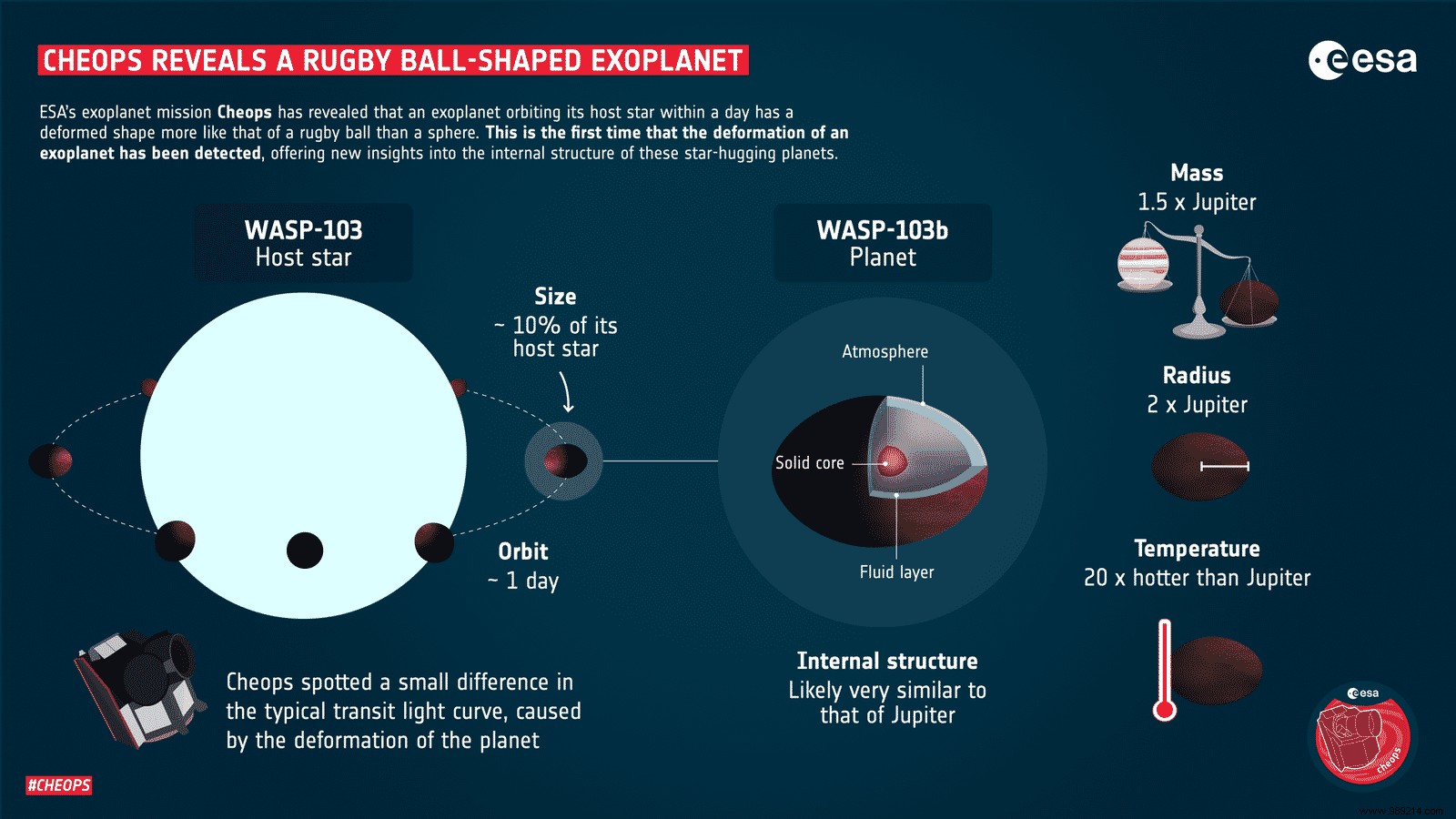
Planets with ultra-short orbital periods endure extreme conditions, making them prime subjects for planetary physics research. Alongside scorching temperatures, they face powerful tidal forces that distort their shapes. WASP-103b, discovered in 2014 and 1.5 times Jupiter's size, exemplifies this.
Orbiting about 1,530 light-years from Earth, WASP-103b is a hot Jupiter—a gas giant like Jupiter but hugging its star closely, completing an orbit in under one Earth day. Unlike Jupiter's sphere, this planet is oblong, stretched longer than it is wide, akin to a rugby ball.
Led by Susana Barros from Spain's Institute of Astrophysics, the team examined WASP-103b's transit light curve—the dimming of starlight as the planet passes in front of it from our view.
Using data from the CHEOPS space telescope, designed for exoplanet characterization, they integrated observations from Hubble and Spitzer. This analysis revealed the planet's mass distribution.
A planet 1.5 times Jupiter's mass should be roughly spherical, but WASP-103b's proximity to its star causes tidal forces to warp it into an ovoid.
"It's remarkable that CHEOPS detected this subtle deformation," says Jacques Laskar from Paris Sciences and Letters University. "This pioneering analysis paves the way for longer-term observations to refine our understanding of the planet's internal structure."
Future James Webb Space Telescope observations could refine WASP-103b's radius measurements. Currently, JWST is en route to the L2 Lagrange point, arriving January 29.
