Astronomers at the University of Copenhagen have identified two previously undetected primitive galaxies over 13 billion light-years away, hidden behind thick dust veils. Using radio waves, they've revealed these cosmic relics, indicating the early universe held far more galaxies than previously estimated.
The Hubble Space Telescope excels at peering deep into the cosmos, effectively glimpsing the universe's infancy through ultraviolet and visible light. Yet it can't detect everything. Complementary instruments tuned to other wavelengths, like radio, fill these gaps and uncover hidden details—as in this breakthrough.
"We were studying a sample of very distant galaxies already known from Hubble," explains Pascal Oesch of the University of Copenhagen. "Then we spotted neighbors in two of them that Hubble missed due to surrounding dust blocking their light."
The team used the Atacama Large Millimeter/submillimeter Array (ALMA) in Chile, expert at capturing radio emissions.
Dubbed REBELS-12-2 and REBELS-29-2, their light took just over 13 billion years to reach us. Accounting for cosmic expansion, they're now more than 29 billion light-years from Earth.
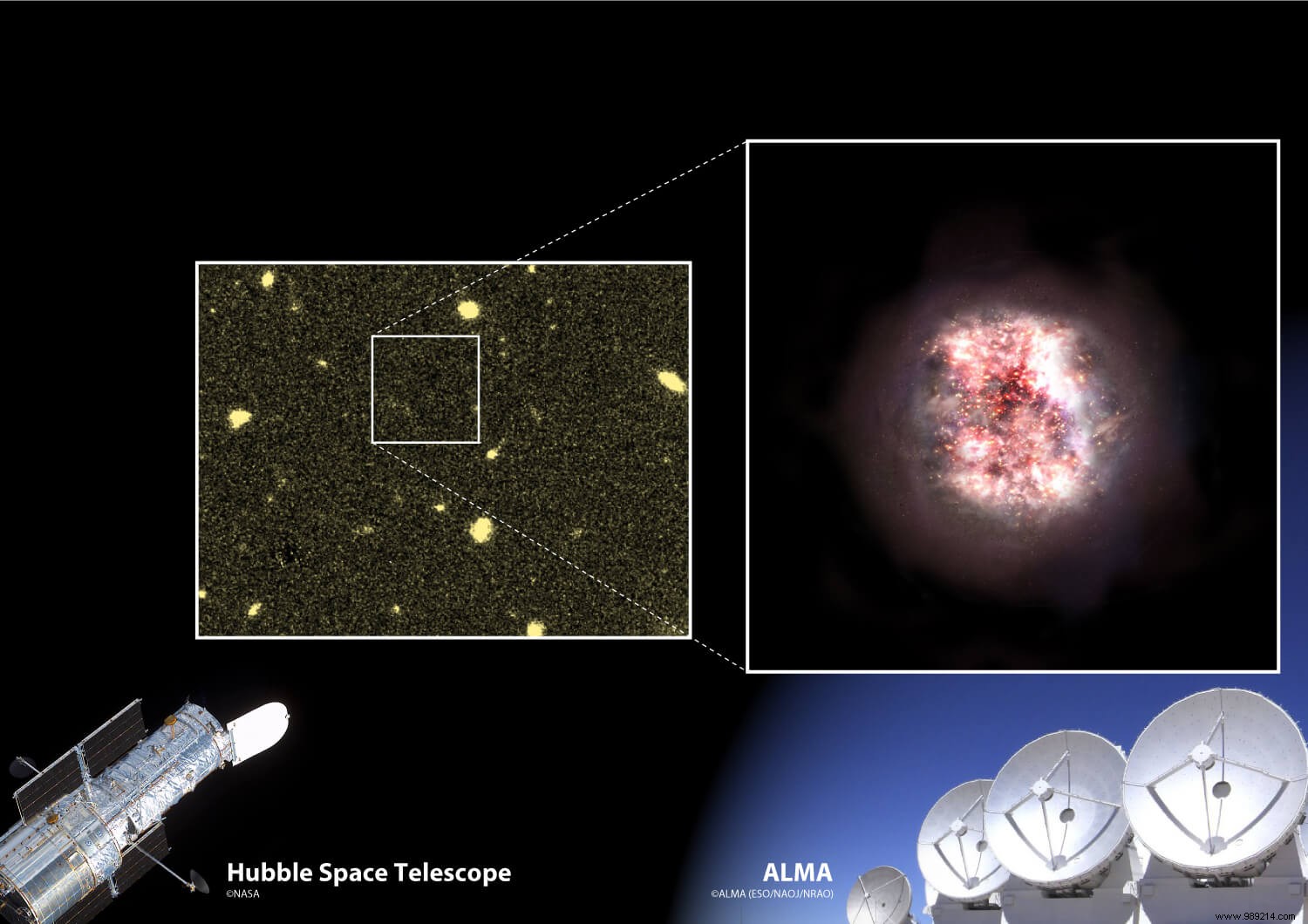
The researchers estimate that 10-20% of galaxies from the universe's reionization era lurk behind similar dust shrouds. This implies the primordial universe brimmed with even more galaxies.
"We're piecing together the universe's formation puzzle and tackling the core question: where did all this matter originate?" Oesch adds. "Our find shows up to one in five earliest galaxies evaded detection. Accurate census is step one to understanding galaxy formation."
Soon, the James Webb Space Telescope, infrared specialist launching December 22nd, will peer through dust and delve deeper.
Study details published in Nature.
