Researchers using data from the Dark Energy Spectroscopic Instrument (DESI)'s first survey have created the most extensive 3D map of the universe yet. This stunning visualization showcases a vast cosmic web of galaxies stretching across billions of light-years—and it's only the start of an ambitious project.
Astronomers have long known the universe is expanding, with that expansion accelerating over time as galaxies recede faster and faster. This phenomenon is driven by dark energy, a mysterious repulsive force counteracting gravity that makes up about 68% of the universe's total energy density. Dark energy will ultimately decide the cosmos's destiny: endless expansion leading to a "Big Rip," or perhaps a collapse known as the "Big Crunch"?
To unravel dark energy's nature, the U.S. Department of Energy's Office of Science funded DESI, a cutting-edge instrument designed to measure the positions and motions of tens of millions of galaxies. These observations enable unprecedented precision in tracking the universe's accelerating expansion.
DESI achieves this through a sophisticated setup: light from distant galaxies passes through six large lenses, then into an array of fiber-optic cables positioned by 5,000 robotic actuators with micron-level accuracy—down to 10 microns. The light then feeds into 10 spectrographs that disperse it into its spectral colors for detailed analysis.
This precision allows DESI to capture high-resolution spectra from millions of galaxies, revealing their redshift—the stretching of light indicating distance and recession speed.
After two years of operation, DESI released its inaugural universe map just days ago. It charts 7.5 million galaxies across about five billion light-years toward the Virgo constellation, highlighting immense clusters and filaments that weave the cosmic web—the universe's largest structures.
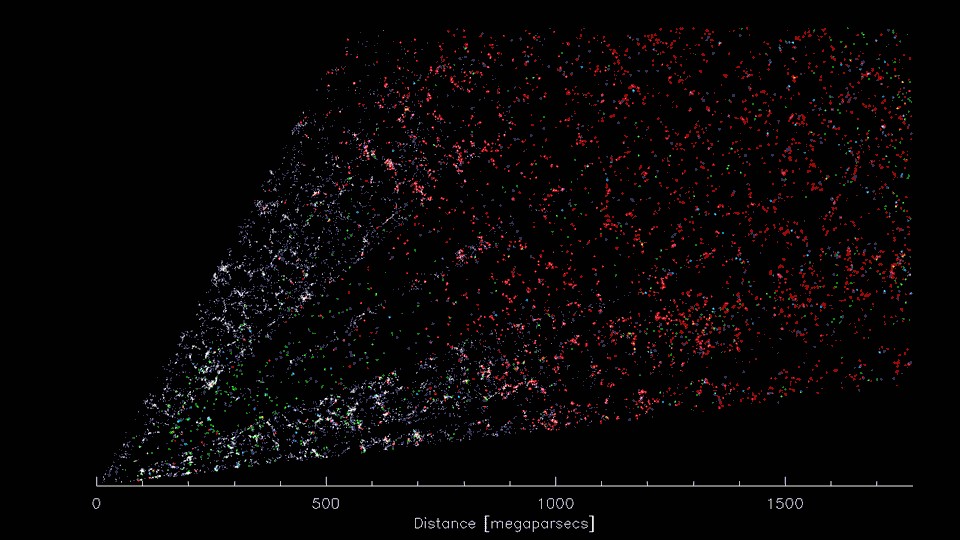
This is merely the beginning. By the end of its primary mission in 2026, DESI will have cataloged more than 35 million galaxies spanning up to eleven billion light-years.
DESI isn't alone in probing dark energy. The European Space Agency's Euclid mission complements it with a space telescope featuring a visible-light imager (VIS) and a near-infrared spectro-imager (NISP). Its launch was planned for 2022.
Together, these efforts promise answers to humanity's profound questions: Where do we come from, and where are we headed?
