The European Space Agency (ESA) is advancing its trailblazing Comet Interceptor mission to rendezvous with an incoming comet. Launch is targeted for 2028.
We've explored comets before, including the Giotto probe's close flyby of Halley's Comet on March 13, 1986. In 2016, ESA's Rosetta mission achieved a historic landing on Comet 67P/Churyumov-Gerasimenko. These missions have provided invaluable insights into our Solar System's origins and evolution. Yet, the comets studied so far are short-period visitors, having orbited the Sun for millions of years and undergone significant alteration.
ESA now aims to target a long-period comet—a "pristine" relic whose surface remains untouched by solar radiation.
The mission deploys three spacecraft—a mothership and two probes—to the Sun-Earth L2 Lagrange point, 1.5 million km from Earth, where gravitational forces balance perfectly.
Positioned for multi-angle observations, each carries specialized instruments: the first features a high-resolution camera, multispectral infrared imager, and dust analyzer; the second includes a hydrogen imager, plasma instrument, and wide-angle camera; the third specializes in mapping the comet's nucleus.
Success promises unprecedented study of an object virtually unaltered since the Solar System formed 4.6 billion years ago.
ESA recently greenlit the mission, selecting Thales Alenia Space in the UK for the mothership and JAXA (Japan) for the probes. Launch aligns with the ARIEL telescope in 2028, which will probe exoplanet atmospheres.
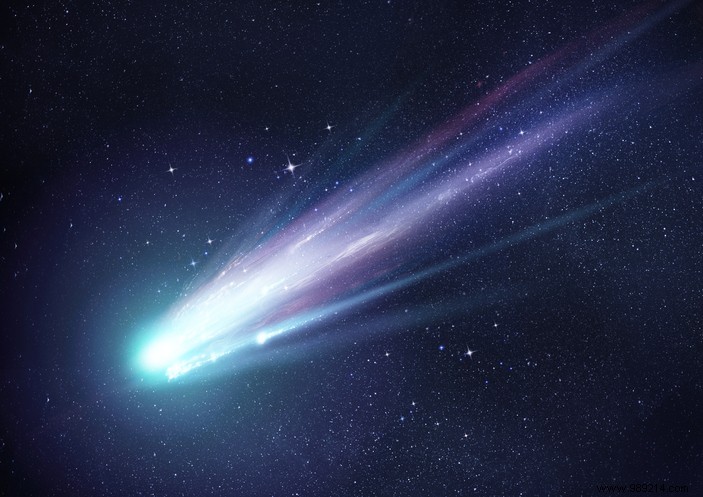
This mission is a bold wager: spacecraft must be ready before a target is identified. Fortunately, observatories like Pan-STARRS in Hawaii deliver near-real-time detection of inbound comets. The fleet will lie in wait at L2, ready to pivot upon discovery for detailed analysis.
With luck, it could even intercept interstellar visitors, as 'Oumuamua's 2017 passage revealed such events may be more common than once thought.
