Peering 10 billion years into the universe's past, the Hubble Space Telescope has uncovered two pairs of closely spaced quasars—a discovery astronomers liken to finding two needles in a cosmic haystack.
Quasars rank among the universe's brightest objects, fueled by supermassive black holes at galaxy centers that devour vast amounts of matter. This process unleashes immense energy as electromagnetic radiation, making quasars visible across cosmic distances.
During galaxy mergers—more common billions of years ago—two such quasars can form a "double quasar." Spotting them requires scanning the distant universe, a challenging endeavor.
"We estimate that in the distant universe, there is one double quasar for every thousand quasars," explains Yue Shen from the University of Illinois at Urbana-Champaign. "Finding these double quasars is like finding a needle in a haystack."
A research team recently identified these elusive pairs using Hubble, located more than 10 billion light-years away. From Earth, they appear as mere points of light.
While about a hundred double quasars have been found in merging galaxies, none match the antiquity of these two discoveries.
Published in Nature Astronomy, this study sheds light on early galaxy collisions and black hole mergers. "This is the first reliable sample of double quasars from the peak epoch of galaxy formation, allowing us to probe how supermassive black holes form binaries," notes Nadia Zakamska from Johns Hopkins University.
These mergers influence galaxy evolution: gravitational interactions funnel gas to black holes, igniting quasars. Over time, powerful outflows from these radiant cores clear surrounding gas, halting star formation and shaping elliptical galaxies.
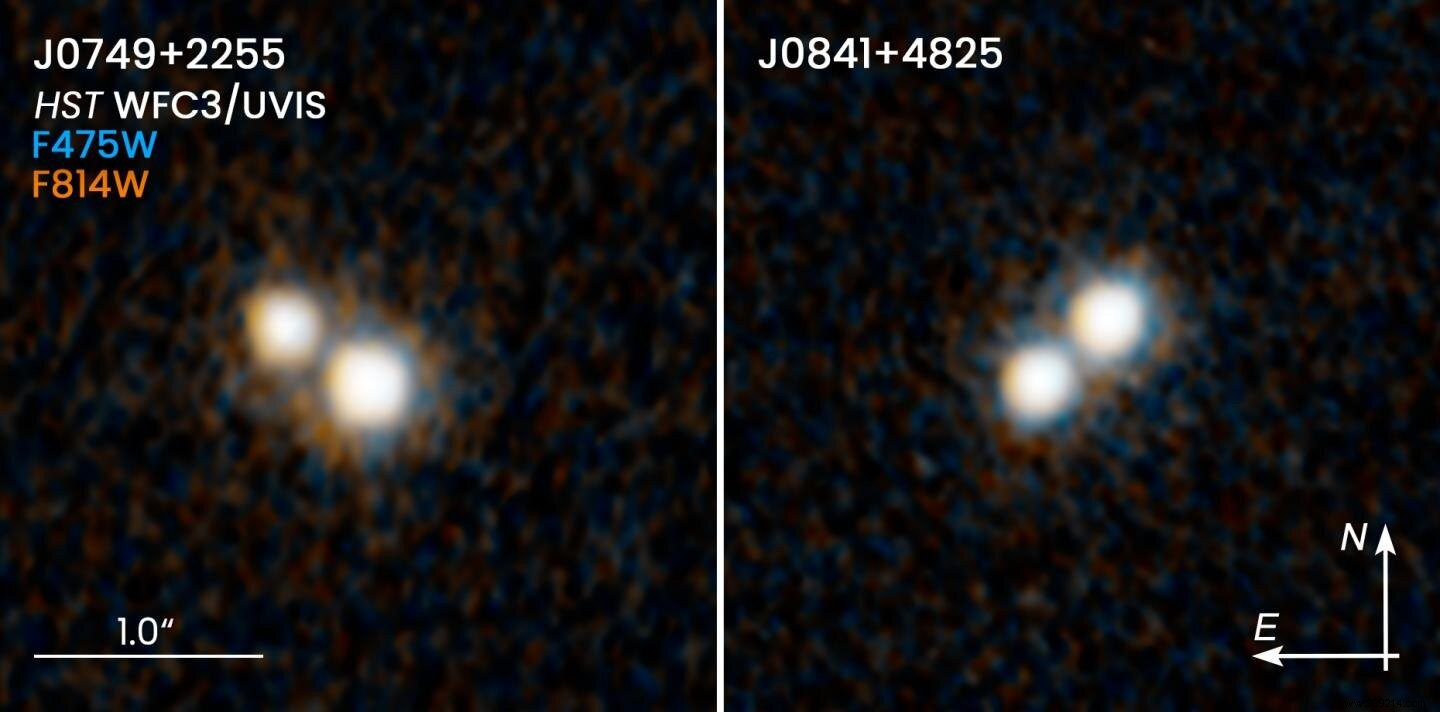
Though gravitational lensing—where a foreground galaxy distorts a background quasar's light into duplicates—is possible, researchers deem it highly unlikely. Hubble detected no such foreground galaxies near these pairs.
