The gnomon—a simple stick planted vertically in the ground—was a key tool in ancient Babylon. Remarkably, this 4,000-year-old technique was revived by NASA engineers for the InSight mission to determine the geographic North Pole on Mars.
Over 4,000 years ago, Babylonians used a vertical stick on flat ground to track shadows, revealing time, seasons, and geographic coordinates. This foundational astronomical tool informed early celestial constants.
For NASA's InSight mission, engineers at the Paris Observatory (as detailed in their April 19, 2021 publication) evaluated two methods to find Mars' True North: the probe's gyroscope or shadow casting. They selected the shadow method, targeting accuracy better than 5°.
InSight lacked a traditional gnomon but applied the same principle. A camera on an articulated arm captured the shadow cast by the seismometer (SEIS) gripping hook against a graduated staff. This yielded an impressive ±3° accuracy—exceeding NASA's goals.
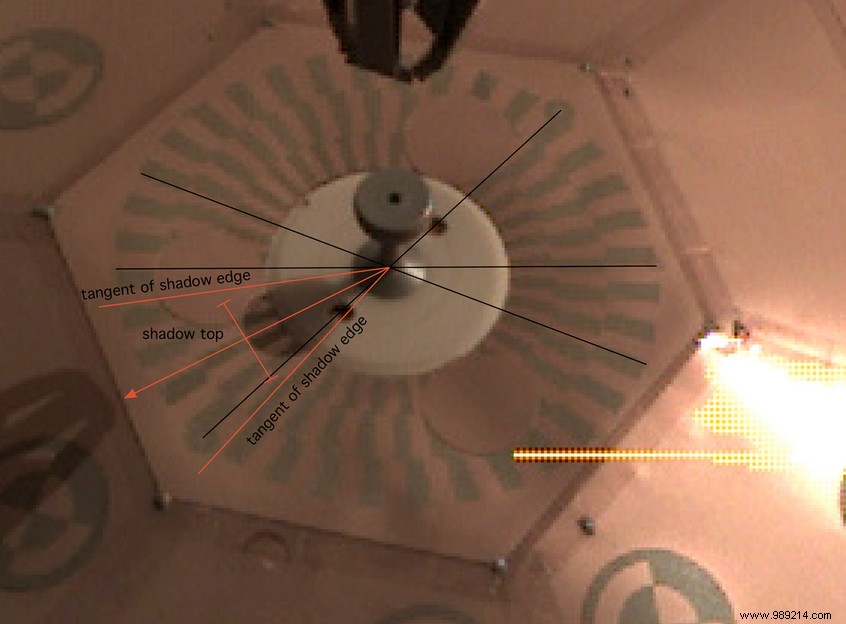
Precisely measuring the shadow's position proved challenging, yet the results were outstanding.
In early April 2021, InSight detected two Marsquakes of magnitude 3.1 and 3.5. Teams are also working to bury the seismometer cable for weather protection. The mission's core aim: unravel Mars' internal structure to reconstruct its geological history and unknown traits.
