NASA's InSight lander has detected two new Marsquakes measuring 3.1 and 3.5 in magnitude. The team is also working to bury the seismometer cable connecting it to the lander, shielding it from harsh weather conditions.
NASA's InSight lander touched down successfully in November 2018 on the western edge of Elysium Planitia, a vast lava plain near Mars' equator. Its primary mission is to capture faint seismic waves traveling through the planet's interior, revealing insights into its composition. Unlike Earth, Mars lacks active tectonic plates, but it features seismically active zones capable of generating tremors.
Since landing, InSight has recorded over 500 marsquakes. Two stand out as larger than average, detected on March 7 and 18 with magnitudes of 3.1 and 3.5. Both originated in Cerberus Fossae, a region marked by parallel fault lines.
Previously, only two stronger events had been detected—magnitudes 3.6 and 3.5—also from this area. These latest findings reinforce Cerberus Fossae as a key seismic hotspot on Mars.
"We've observed two distinct tremor types during the mission: some more 'lunar-like' with dispersed waves, and others 'Earth-like' with direct paths," explains Taichi Kawamura from France's Institut de Physique du Globe de Paris, a key contributor to InSight's seismometer. "Notably, the four largest events from Cerberus Fossae resemble those on Earth," he adds.
These quakes share another trait with prior major events: they struck during Mars' northern summer, when winds are calmer. Last northern winter, high winds drowned out detections entirely.
With calmer winds, the team is enhancing detection sensitivity. A primary concern is the cable linking the seismometer to the lander, which generates noise from extreme temperature swings (-100°C nights to 0°C days).
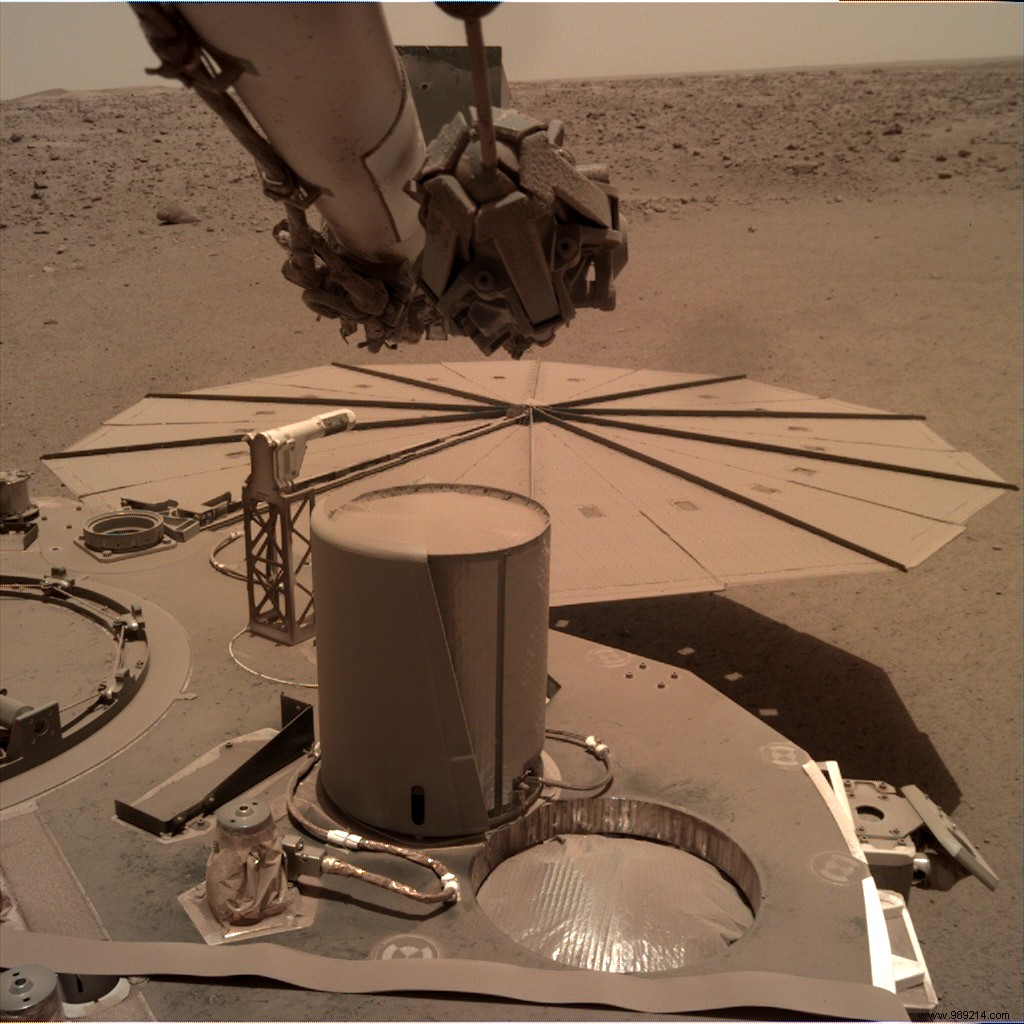
A key goal for the mission extension through December 2022 is to fully bury this cable, insulating it from weather effects. Efforts have begun: InSight's robotic arm scoops soil with its scoop and drops it onto the lander's dome shield, allowing dirt to cascade over the cable.
Meanwhile, as Mars drifts farther from the Sun, InSight's power is waning—its solar panels are dust-covered, as shown above. Levels should rebound after July when Mars nears the Sun again.
Until then, the team will power down instruments sequentially for a hibernation mode, with periodic wake-ups to monitor health and relay data to Earth.
