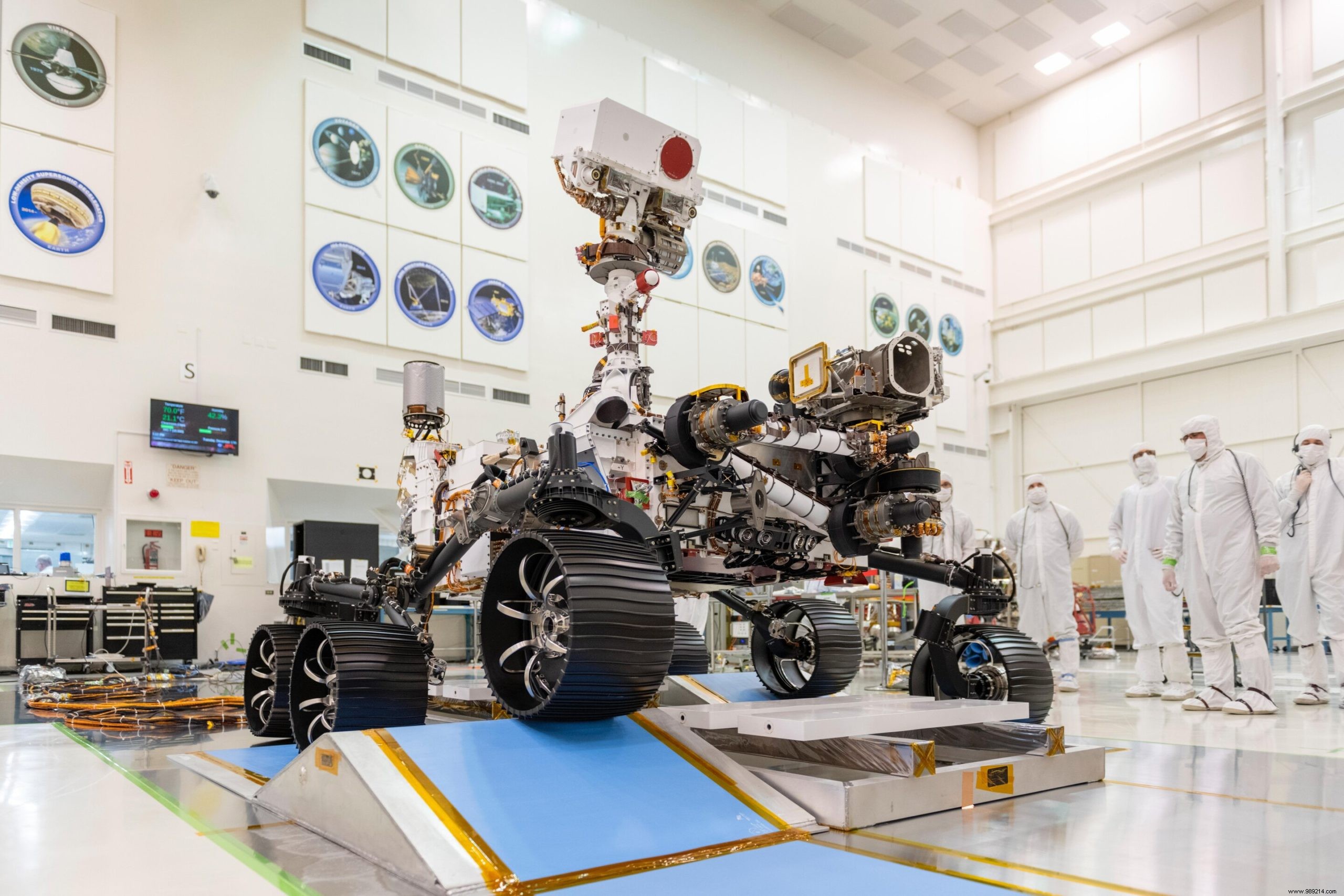
NASA's Perseverance rover, launched on July 30, 2020, is set to touch down in Jezero Crater on February 18, 2021. As seasoned space enthusiasts with years tracking Mars missions, here's your expert guide to this landmark event.
Since launch, the U.S.-built Perseverance rover has journeyed toward the Red Planet. If all systems perform as engineered, this compact-car-sized marvel—the most advanced and heaviest rover ever dispatched to Mars—will cap its six-month voyage with a precise landing.
Achieving a safe touchdown on Mars remains one of spaceflight's toughest challenges. Historically, just 40% of missions have succeeded since the 1960s. Some probes overshot the planet entirely, while others met catastrophic ends on the surface. For Perseverance, anticipation runs high.
A successful landing would mark NASA's fifth Mars rover, building on the legacies of Sojourner (1997), twins Spirit and Opportunity (2004), and Curiosity (2012).
Once active, Perseverance will scour Jezero Crater—a 45-kilometer-wide basin that once cradled a river delta feeding into an ancient lake 3.5 billion years ago. Any microbial fossils from Mars' past could lurk just beneath the surface rocks.
NASA streams the event live on its website starting at 2:15 p.m. ET (8:15 p.m. French time). French speakers can tune into the Astro Alex YouTube channel—Espace &Aéro—from 8 p.m.
Expect a restrained celebration this time, shaped by the pandemic. At NASA's Jet Propulsion Laboratory (JPL) in Pasadena, California, only essential masked personnel will be present to curb COVID-19 spread.
For the thousands of engineers behind Perseverance, tension is palpable. "It's a bit surreal," shares Swati Mohan, Mars 2020 Guidance, Navigation, and Control Operations Manager. "The team has done everything possible pre-landing. Now, we trust our preparation to carry us through."
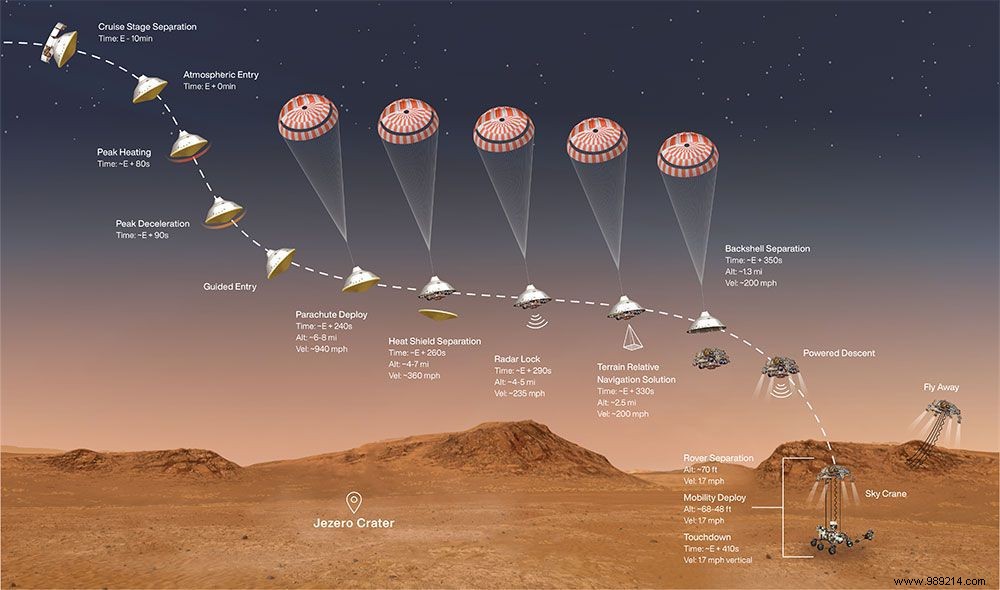
After six months in transit, entry, descent, and landing (EDL) unfolds in just seven intense minutes—the mission's highest-risk phase. Communications lag adds drama: signals from Perseverance take 11 minutes and 22 seconds to reach Earth.
By the time mission control detects atmospheric entry, the rover will have already landed—or not. No real-time intervention possible; Perseverance must land fully autonomously.
Key milestone: around 3:38 p.m. EST (9:38 p.m. French time), the capsule separates from the cruise stage. Ten minutes later, it slams into the thin Martian atmosphere at nearly 20,000 km/h. A supersonic parachute deploys to brake, mimicking aircraft approach procedures.
Nearing the surface, the descent stage releases the parachute, then lowers Perseverance via three cables at 21 meters altitude. Sensors detect slack as the rover touches down, triggering the stage to veer away and crash about 150 meters distant.