The U.S. Air Force's X-37B spaceplane has now exceeded 500 days in Earth orbit, executing a mix of disclosed and classified experiments. Details on the OTV-6 mission's return remain undisclosed.
Among the Pentagon's advanced assets is the X-37B, a highly classified orbital test vehicle. Measuring about nine meters long, 4.6 meters wide, and weighing roughly five tons, it resembles a scaled-down version of the Space Shuttle, operating at altitudes between 250 and 800 km.
Launched in September 2017 aboard a SpaceX rocket for its fifth mission (OTV-5), the X-37B was initially slated for 270 days but extended to a record-breaking 780 days, landing in October 2019 at NASA's Kennedy Space Center Shuttle Landing Facility.
Like prior missions, much of OTV-5 remained classified, though the Air Force noted it tested reusable spacecraft technologies to advance long-term U.S. space objectives.
Managed by the U.S. Space Force's Delta 9, the program supports "preparing, presenting, and projecting assigned and attached forces for protective and defensive operations, providing national decision-makers with options to deter—and if needed, defeat—orbital threats," per the Schriever Space Force Base fact sheet.
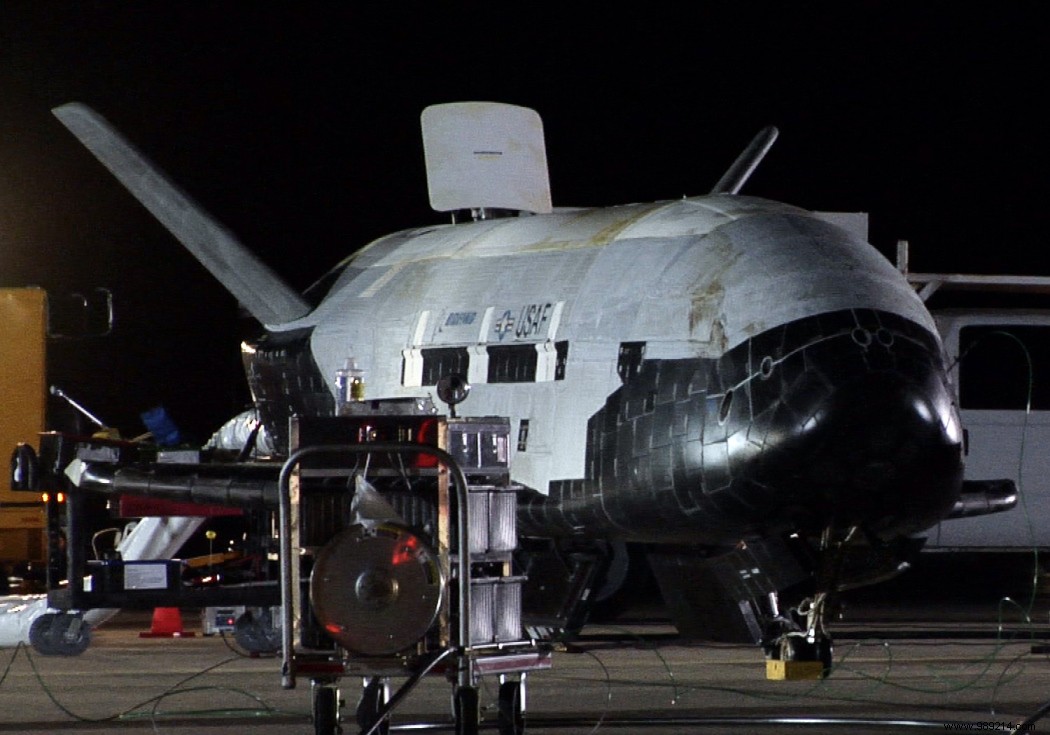
OTV-6 launched May 17, 2020, from Cape Canaveral, Florida, atop a United Launch Alliance Atlas V rocket. Designated USSF-7 by the Space Force, this secretive drone has now orbited Earth for over 500 days, with the full duration still classified.
This mission introduces a service module at the vehicle's aft end for experiments. While core objectives stay classified, several payloads were publicized pre-launch.
The Naval Research Laboratory's PRAM experiment converts solar energy to radio-frequency microwave power. The Air Force Academy's FalconSat-8 satellite performs multiple orbital tests.
Two NASA payloads examine space environment effects on material samples and seeds for space-grown food.
