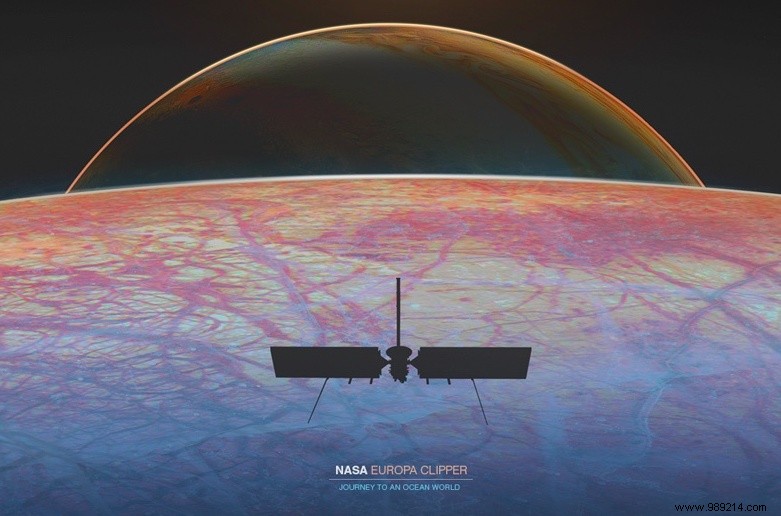
NASA's Europa Clipper mission, originally slated for launch on the agency's powerful SLS rocket in 2024, has pivoted to a commercial provider due to SLS delays and scheduling priorities. This shift means a longer journey to Jupiter, but ensures the mission stays on track.
In 2019, NASA announced plans to investigate Europa, Jupiter's intriguing moon with a vast subsurface global ocean—potentially salty and life-sustaining. The Europa Clipper probe aims to answer that question through dozens of close flybys.
Over four years in the Jovian system, the spacecraft will conduct low-altitude overflights of Europa (25 to 2,700 kilometers above the surface), analyzing its icy crust with advanced instruments on each pass.
A key goal is capturing high-resolution images to identify prime landing sites for future missions.
Europa Clipper was initially mandated for launch on NASA's SLS rocket, designed for crewed Artemis lunar missions, with arrival in the Jovian system in about three years.
SLS development delays and escalating costs prompted NASA's planetary science leaders to opt for a private rocket, as confirmed by mission project scientist Bob Pappalardo. This prioritizes SLS for Artemis while leveraging commercial capabilities.
Congressional directives allowed SLS "if available," opening the door for alternatives. NASA has about a year to select the provider, with frontrunners being SpaceX's Falcon Heavy and United Launch Alliance's Delta IV Heavy.
Unlike SLS's direct trajectory enabling arrival in under three years, commercial heavy-lift rockets require gravity assists from Mars (February 2025) and Earth (December 2026) to build speed.
This extends the voyage to about five and a half years, with arrival between late 2029 and early 2030.
