Astronomers using the ALMA telescope array in Chile have achieved the first unambiguous detection of a circumplanetary disk around an exoplanet—one massive enough to form multiple moons.
Planets form within protoplanetary disks of gas and dust encircling young stars. These hot accretion disks cool over time, enabling solid particles like rocks and ice to condense, collide, and grow into planetesimals. These planetesimals then aggregate into planetary embryos and, eventually, full planets.
During this process, a forming planet can capture its own circumplanetary disk, where gas and dust coalesce into larger bodies that may become moons. Yet, the precise mechanisms remain elusive. "In short, we still don't know when, where, and how planets and moons form," explains Stefano Facchini, an ESO researcher, highlighting the significance of this discovery.
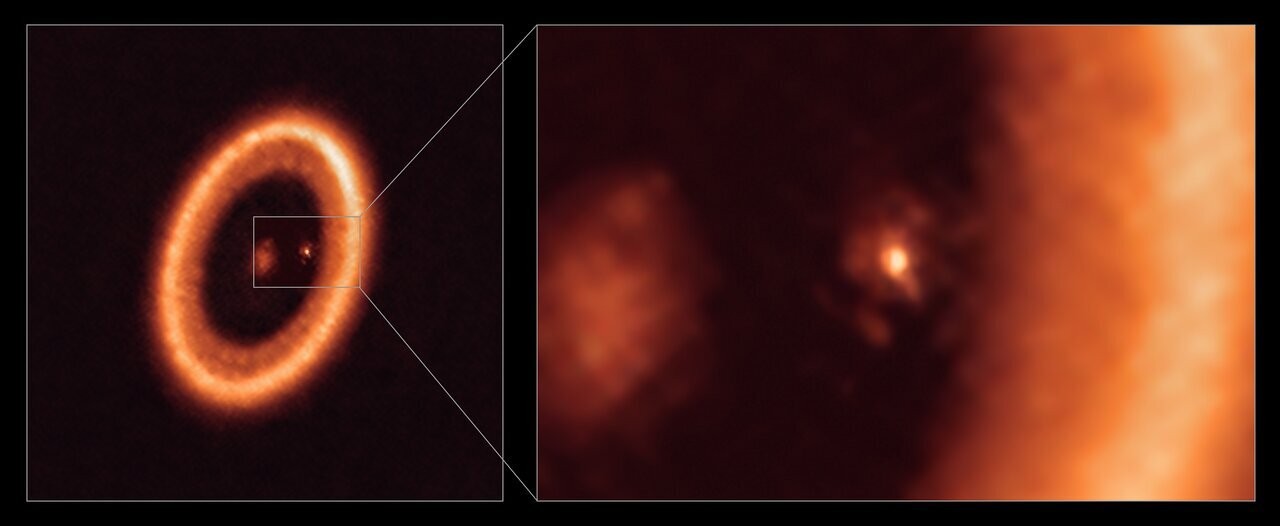
Analyzing ALMA data from Chile, Dr. Facchini's team confirmed a circumplanetary disk around the exoplanet PDS 70c.
This gas giant orbits alongside PDS 70b around a star approximately 400 light-years from Earth. The disk spans roughly the Earth-Sun distance—about 150 million km—and holds enough material to form three Moon-sized satellites.
"Our work presents a clear detection of a disk in which satellites could form," states lead researcher Myriam Benisty from the University of Grenoble, France. "Our ALMA observations were obtained at such exquisite resolution that we were able to clearly identify that the disk is associated with the planet and constrain its size for the first time."
Notably, PDS 70b shows no evidence of a similar disk.
These findings illuminate planet formation in young systems. "More than 4,000 exoplanets have been found so far, but all have been detected in mature systems," notes Miriam Keppler from the Max Planck Institute for Astronomy in Germany. "PDS 70b and PDS 70c, which form a system reminiscent of the Jupiter-Saturn pair, are the only two exoplanets detected to date that are still in the process of formation."
Future observations with ESO's Extremely Large Telescope (ELT), under construction in Chile's Atacama Desert, will probe this system further.
