Astronomers at the University of California, San Diego, have uncovered a 'highway network' across the Solar System, enabling significantly faster travel than previously thought possible.
Imagine traversing the Solar System in record time. In a study published in Science Advances on November 25, 2020, UC San Diego researchers detailed this network by analyzing its structure and impact on comets and asteroids. They describe 'spatial manifolds'—geometric structures akin to folding a flat pattern into a cube.
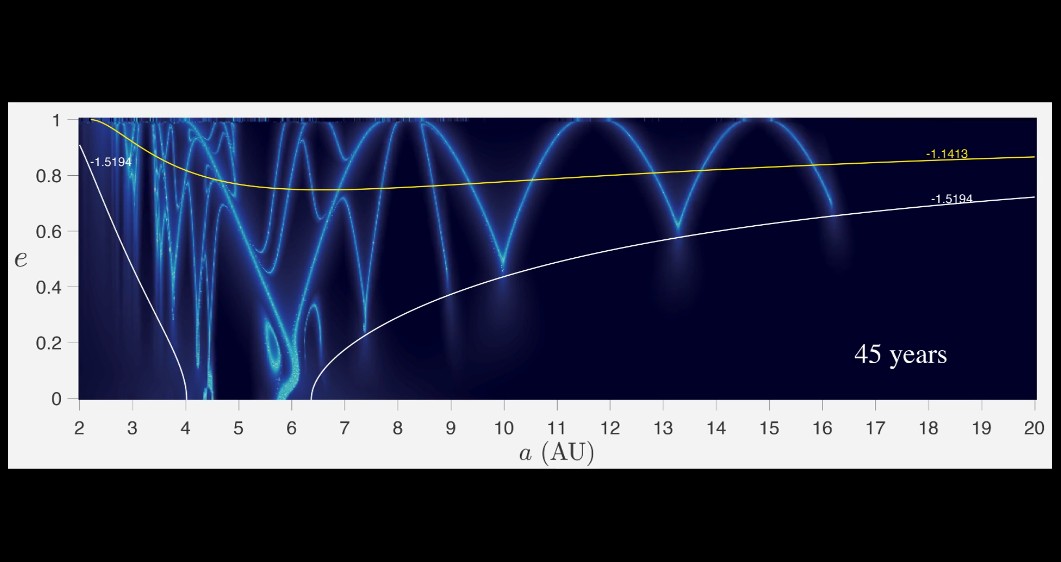
"We reveal remarkable ornamental structure and hitherto undetected varieties connected by a series of arcs that stretch from the asteroid belt to Uranus and beyond," the study leads explained in a press release.
This network allows objects near Jupiter to reach Neptune in just a decade. Within less than a century, they could cover about 100 astronomical units (AU)—where 1 AU is roughly 150 million kilometers, the Earth-Sun distance. Traditional estimates for such journeys span hundreds of thousands or millions of years.
Jupiter's dominant manifolds stem from its powerful gravitational pull, influencing Jupiter-family comets and centaurs—icy bodies orbiting between Jupiter and Neptune. Missions like Voyager 1 and 2 harnessed this gravity for acceleration to the Solar System's outer edges, validating these decade-scale transfers.
