Any extraterrestrials visiting Earth would almost certainly be artificial intelligence, not biological beings, argues Seth Shostak, senior astronomer at the SETI Institute.
Seth Shostak, a leading astronomer at the nonprofit SETI Institute—dedicated to the search for extraterrestrial intelligence—shared these insights in a recent The Guardian opinion piece. Drawing from decades of expertise in astrobiology and interstellar communication, Shostak dismisses claims of past alien visits.
He firmly states that extraterrestrials have never entered our airspace. “Claims that extraterrestrials helped build large, pointed monuments in the Egyptian desert 5,000 years ago are frankly laughable,” he writes. “And I don't think the footage from the Navy's F-18 Hornet cameras shows any alien craft hurtling through the skies over the Pacific. There are more prosaic explanations for these images.”
Yet Shostak believes intelligent life is abundant in our galaxy, making future contact highly probable. The key question: What would these visitors look like?
Hollywood's depictions of frail, big-headed gray aliens are overly anthropomorphic, Shostak contends. “It is unlikely that the extraterrestrials that will come to our planet, if they ever come, are carbon-based life forms, that they are either hairy or hairless,” he explains. “Their cognitive abilities are unlikely to be powered by a spongy mass of cells we would call a brain. They will probably have gone beyond biological intelligence and, in fact, beyond biology itself.” In short, “they will not be alive.”
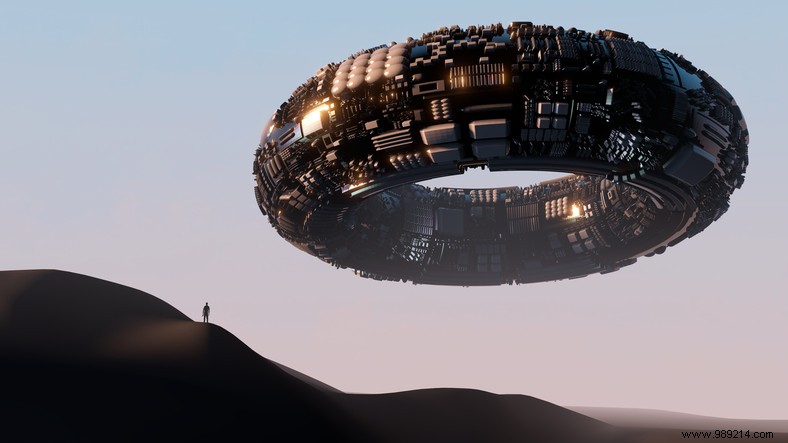
Interstellar distances are immense. Even reaching Alpha Centauri—4.2 light-years away—would take over 75,000 years with current propulsion. Human crews would require massive generational ships; researchers like Frédéric Marin and Camille Beluffi calculated a minimum of 98 people aboard a vessel at least 224 meters in radius and 320 meters long.
Advanced aliens might have superior tech, but physics sets limits. “Suppose an alien wishes to cover the distance between Proxima Centauri and Earth in 10 years. Their rocket would need to muster 600 million times more energy than a Saturn V rocket. Double that number if they plan to stop on Earth and engage with the locals.”
Biological travelers couldn't endure millennia-long voyages. “Machines, on the other hand, won't complain if they're locked up in a spaceship for tens of thousands of years. They do not need food, oxygen, sanitation, or entertainment. And they don't require a return ticket,” Shostak notes. “Therefore, it is reasonable to expect any cosmic intelligence visiting us to be synthetic.”
Physical form might then be irrelevant, but their intentions could pose profound questions for humanity.
